

Introduction
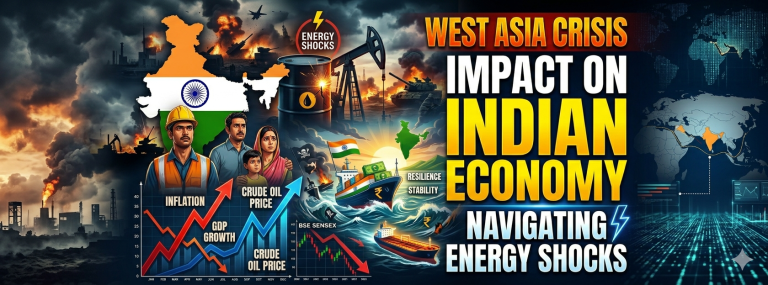
The West Asia crisis impact on Indian economy growth prospects has become increasingly visible as rising oil prices, supply-chain disruptions, and market uncertainty affect growth prospects. The latest example is the fall of the Indian Rupee, which came under major pressure amid the West Asia crisis in 2026. The Indian Rupee has broken past the key psychological threshold, hovering around 95.60 to 96.00 against the US dollar.
India is facing its consequences, the most important being increasing pressure on the rupee, rising crude oil prices, and fear of inflation. We can also see this effect on our homes due to the availability and affordability of cooking gas and transport fuel.
India imports nearly 91% of its crude oil requirements, with over 54% sourced directly from the West Asian region. Hence, tensions and instability in oil-producing regions have directly affected our country’s economic stability. The recent depreciation of the rupee is not merely a currency fluctuation, but it shows how a global geopolitical crisis can have a directeffect on our day-to-day lives.
Historical Precedents: Past West Asia Crisis Impacts On The Indian Economy
This is not the first time India has faced a critical challenge. India has been facing similar economic challenges during periods of international conflict and energy instability.
One of the major examples was the 1990 Gulf War, when Iraq’s invasion of Kuwait caused global oil prices to rise sharply. Even at that time, India was heavily dependent on imported oil, with imports accounting for roughly 40% of its oil requirements. However, the crisis was triggered not only by this dependence but also by the sudden doubling of global oil prices and the loss of substantial remittance inflows as thousands of Indian workers were evacuated from Kuwait and other affected Gulf regions. As a result, foreign exchange reserves declined rapidly, the rupee came under pressure, and India eventually entered the Balance of Payments crisis of 1991.
The country was forced to pledge its gold reserves to secure emergency loans, paving the way for the landmark economic reforms of 1991.
Recently, we can see a similar example with the Russia-Ukraine conflict that disturbed global energy markets, increased inflation, and weakened several import-dependent economies. These major historical lessons teach us that often it’s the countries that heavily depend on global energy supplies that pay the price when politically important regions become unstable.
Why The Rupee Is Under Pressure
The current crisis in West Asia, particularly the conflict countries such as Iran, Israel and regional armed groups, has once again created instability in global markets. Investors and the government fear disturbances in critical oil supply routes such as the Strait of Hormuz, through which a major portion of the oil trade passes. These disruptions tend to increase global crude oil prices. With the rise of oil prices, countries like India face higher import bills, putting extra pressure on the value of their currencies.
During these times of uncertainty, investors try to shift their money towards safer assets such as the US dollar and US treasury bonds. This strengthens the dollar globally while weakening the developing market economies, including the Indian Rupee. Due to this, pressure on domestic currencies increases. Hence, it is not only the higher oil prices but also changing global market prices and global market sentiment that depreciate the rupee.
The weakening of the rupee indicates both domestic shocks and instability within the Indian economy. Since international oil trade is largely operated in US dollars, rising crude prices automatically increase India’s demand for dollars. This increases the current account deficit and places downward pressure on the rupee.
The Cost Of A Falling Currency
A weaker rupee, in turn, makes imports more expensive, particularly fuel, industrial inputs, electronics, and fertilisers. These increased costs directly affect the consumers, increasing inflation across sectors. One of the most visible consequences of a falling rupee is the rise in fuel prices, which have increased by 7.5 rupees per litre in less than two weeks. Higher transportation and production costs affect almost every part of the economy, from food prices to manufacturing expenses. Inflation reduces household purchasing power and creates additional economic pressure on middle- and lower-income groups.
RBI’s Balancing Act
During periods of geopolitical uncertainty, the Reserve Bank of India (RBI) often intervenes to limit excessive volatility in the rupee through measures such as deploying foreign exchange reserves. While these tools can provide short-term stability, their effectiveness may diminish if global tensions persist and energy prices remain elevated.
Reflecting these concerns, the Monetary Policy Committee recently kept the benchmark repo rate unchanged at 5.25%, citing geopolitical developments and the risk of imported inflation arising from the ongoing West Asia conflict. In such conditions, the RBI faces a delicate balancing act: maintaining currency stability, controlling inflation, and supporting economic growth simultaneously.
Building Long-Term Economic Resilience
Despite these challenges, the current crisis forces us to think and act upon India’s long-term economic strategy. To strengthen India’s resilience against future geopolitical and energy shocks, policymakers should focus on:
• Expanding renewable energy capacity, particularly solar and green hydrogen projects, to reduce dependence on imported fossil fuels.
• Augmenting Strategic Petroleum Reserves (SPRs) to provide a buffer against sudden disruptions in global oil markets.
• Diversifying energy suppliers and trade routes to reduce excessive dependence on any single region.
• Investing in domestic energy infrastructure to improve long-term energy security and economic stability.
• Developing alternative payment and settlement mechanisms to reduce vulnerability to external financial disruptions.
India has recently explored conducting trade in local currencies with certain countries to reduce dependence on the US dollar. This can be seen in its arrangements with Russia and the United Arab Emirates. Following Western sanctions on Russia, India initiated a Rupee-Ruble payment mechanism for a portion of its energy imports. However, the arrangement has faced significant hurdles due to trade imbalances, as Russia has limited use for the large volumes of rupees it accumulates through exports to India. As a result, India has increasingly relied on alternative non-dollar settlement mechanisms, including payments in the UAE Dirham (AED), particularly for strategic energy purchases.
While such measures may not immediately replace the dollar-dominated global financial system, they reflect India’s efforts to diversify payment channels and reduce vulnerability to external financial pressures during periods of geopolitical uncertainty.
Conclusion
If tensions in West Asia persist, India is likely to face continued pressure on the rupee, elevated inflation, and higher energy import costs. However, the larger lesson extends beyond currency movements or oil prices. The current crisis demonstrates how deeply interconnected geopolitics and economics have become in an era of globalisation.
For India, economic resilience can no longer be viewed separately from energy security and strategic preparedness. Strengthening domestic energy capacity, diversifying trade and payment mechanisms, and building adequate financial buffers will be essential to mitigating future external shocks. As the West Asia crisis shows, conflicts occurring thousands of kilometres away can still shape economic outcomes at home, making resilience as important as growth in India’s long-term economic strategy.