

Abstract
For decades, Indian Foreign Policy remained passive to diplomatic relations with Israel. This classic anomaly was underlined by a four decade long phase of ‘relations without recognition’ (Kumaraswamy, 2010). The initial approach from India was influenced by an Islamic-Prism, citing domestic minority demography and experiencing a turbulent partition, thereby limiting relations to clandestine defence transactions. The same country today depicts how foreign policy can transform to align national strategy with evolving geopolitical reconfigurations. India of the present shares relations with Israel symbolizing a convincing template for global strategic partnership. This article attempts to trace how Indian Foreign Policy pivoted from ideological animosity and moralistic alienation to strategic pragmatism. The purpose of the article is to demonstrate how India-Israel Relations lend a convincing case study on how an emerging global power, India, can maneuver and maintain its strategic consistency of partnerships despite the upwelling of geopolitical conflicts through policy frameworks such as de-hyphenation in the Middle East.
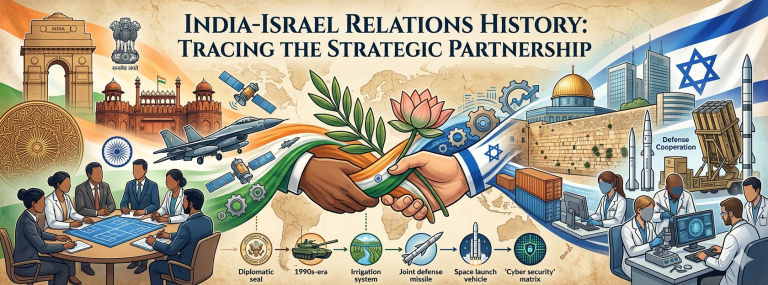
India-Israel Relations History: Tracing the Strategic Partnership
Indian Foreign Policy traces a unique evolution when it comes to its ties with Israel. Examining India-Israel relations history reveals that post-independent India anchored its foreign policy premised on foundational ideological aspirations of anti-colonization and non-aligned movement. Despite our presence in post-world war global politics, India came across several difficult anomalies in establishing diplomatic relations with Israel. For decades, what remained as ‘recognition without relations’ wrapped in clandestine security transactions has evolved into full fledged strategic partnership – one of the most precise strategic maneuvers executed by an emerging global power, India, to align its national interests with the changing geopolitical configurations. This article traces the evolution of India-Israel Relations from Gandhi’s Moralism, Nehru’s passivity, Vajpayee’s breakthrough to Modi-led de-hyphenated policy which has positioned Indian Foreign Policy as one of the most resilient case studies amidst the conflict-ridden middle east.
The Chronological Phases of India-Israel Relations History
(i) Pre-Independent Phase
The genesis of early Indian thought on Israel begins with how Gandhi sparked a thread of discourse on morality and the Jewish state. The moralism shared by both Gandhi and Nehru depict an ahistorically misplaced idea of justice. As the carriers of Indian Political Thought, Gandhi and Nehru planted a contested approach to India’s relations with Israel. As Skiles (2023) observes, the letter on ‘The Jews’ (1938) in the Harijan by Mahatma Gandhi unveiled a series of misplaced equivalence between the holocaust and racial discrimination in South Africa, both events being treated with the same means of satyagraha or non-violence. Moreover, Gandhi’s argument on why Israel cannot claim its national home like other communities without creating the Jewish State, depicted a serious apathy to political realism. Such apathy to political realism can also be traced in the words of Nehru, who, in his reply to Einstein, painted the disapproval of the Israeli State under the garb of a very generic and broad idea of global justice, which became a comfortable excuse for not engaging with the outside world strategically. With Gandhi initiating India’s role in the Khilafat Movement in the 1920s, the internalized contest between the Indian National Congress and the Muslim League on the question of Palestine took shape swiftly. Thereby, while Gandhi’s discomfort with the question of Israel might have misplaced moral echoes, for Nehru, it was much more than morality that revealed his inaction.
The Congress could not advocate for Jewish aspirations in Palestine while opposing a similar demand of Muslim League in India (Kumaraswamy, 2018). This was also the formal position of India as a member of the UNSCOP (1947). At the UNSCOP, the proposal of an autonomous Arab and Jewish state within one federal Palestinian State, was the brainchild of Nehru (Kumaraswamy, 2018; UNSCOP, 1947). However, what Nehru proposed is not what happened at home. India and Pakistan both decided to undergo partition, and Nehru continued to advocate Arab and Islamic countries against the Partition of Palestine. It can be underscored that Nehru’s inaction was not stemming from moralism alone- instead, India’s inertia under Nehru symbolized how domestic struggles and external influences dictated how an independent India would engage with the world marred with uncomfortable realities (Tate, 2020; Kumaraswamy, 2018; Bhaduri, 2023).
(ii) Post-independence Phase : Recognition without Relations to Normalization (1950s to 1992)
Regional dynamics began to change upon unilateral declaration of independence by Zionist leaders, followed by immediate recognition by President Harry S. Truman. Yet, India not only refrained from responding to the appeal of recognition by Moshe Sharret (the then Foreign Minister of Israel) and Mufti-led Palestinian Government, but also voted against the admission of Israel into the United Nations on May 11, 1949. The fundamental premises, as noted by Kumaraswamy of such stance was two-fold : (a) alienation of domestic muslim population and Pakistan’s opportunism in building diplomatic capital by exploiting India-Israel relations; (b) the influence of Arab countries on excluding Israel from Afro-Arab Conference at Bandung (1955), which subsequently rippled in exclusion of Israel from Non-Aligned Movement (NAM) and from the Global South. Nehru’s adherence to decolonization and anti-colonial principles further deferred any deep relations with Israel, which was clubbed with the UK and France in the 1956 Suez Invasion (Vanaik, 2025). However, paradoxically, India was not hesitant in engaging with China (not part of NAM). This revealed the short-sightedness of what was understood as ‘recognition without relations’ as ‘neglect of India’ by P.R.Kumaraswamy (2018), seen in the broader inability to structurally engage with Arab countries and limited external influence during the cold war era.
The status quo was maintained by Lal Bahadur Shastri as well- despite the Arabs siding with Pakistan during Indo-Pak Conflict 1965, the Indian side had been sensitive to perceptions of the Arabs. The relations with Israel remained passive and India’s dependence on the Arabs for oil and domestic muslim population prevailed, and yet, Tel Aviv secretly supplied arms to India during the 1965 Conflict (Grolleau, 2012; Tate, 2020).
With Indira Gandhi’s rise to power, India-Israel relations entered a more tragic phase : she publicly exhibited a firm pro-Palestine cause and sided with the Arabs during the six-day war. Under her regime, PLO (Palestine Liberation Organization) was recognised as the sole legitimate representative of Palestine as well as allowed opening an embassy in 1980. An embassy of Israel was to be waited for 12 years more. Citing commercial prospects of energy security and growing Indian workers in the Gulf, India continued to exercise pro-Arab policy at the cost of establishing full-fledged relations with Israel.
The zero-sum approach to Israel was put to an end when P.V Narsimha Rao established full diplomatic relations with Israel in 1992, which interestingly came after China did the same. This shift in India’s approach to Israel must also be seen in the context of our country recovering from a financial crisis and moving towards a liberalised economic order, hegemonized by the US. Such transition demands a more strategic openness rather than clinging to obsolete moral ideals which fall short before geopolitical challenges. The normalization of India-Israel then took off while balancing its pro-Palestine cause.
(iii) A Wind Of Change : Vajpayee’s Era (1998-2004)
While relations with Israel entered the phase of normalization in 1992, the visit of Israeli Prime Minister Ariel Sharon to New Delhi proved to be the peak of India-Israel relations (Pant, 2004). This came after the watershed moment of 1999 Kargil War where Israel provided India with unacknowledged military assistance, thereby solidifying itself as India’s reliable partner. While domestic backlash continued ascribing India-Israel relations as extension of BJP’s Hindutva ideology, Prime Minister Vajpayee strengthened economic ties not only with Israel but also with Iran and the UAE. The cornerstone of India-Israel partnership took off from alignment to counter-terrorism as the pillar of their respective foreign policies. In the end of Vajpayee era, Israel emerged as the second largest defence supplier to India, followed by Russia. This partnership was benchmarked by the historic USD 1.1 Billion deal with Israel for Phalcon AWACs (Airborne Warning and Control Systems), USD 270 million acquisition of Barak missiles and trade volume reaching USD 1.6 Billion excluding defence in 2003. Such pragmatism amidst criticism paved the way for India to structurally engage with West Asia on strategic terms instead of moral alienation (Pate, 2020; Kumaraswamy, 2010; Pant, 2004; Sharma, et al., 2025).
The Modi Era : Strategic Pragmatism Through De-hyphenation
Since 1992, with the liberalized outreach to the global economy, many state governments in India began to engage with Israel at multiple frontiers. One of many such engagements involved Narendra Modi visiting Israel in the capacity of Chief Minister of Gujarat. Deepening of such engagement exhibited full potentials when under the tenure of Narendra Modi as the Prime Minister, several consecutive high-profile bilateral visits took place- starting from President Pranab Mukherjee visit to Tel Aviv in 2016, Prime Minister Narendra Modi’s visit to Tel Aviv and Palestine in 2017, subsequent visit by PM Netanyahu to New Delhi being the second ever Israeli PM after Ariel Sharon to visit India, followed by various ministerial visits. While the back-door security ties ended with publicly established relations in 1992, and Vajpayee carried the foundations of India’s engagement with Israel to novel heights, under Prime Minister Narendra Modi, India’s foreign policy became more strategic, issue-focussed and showed resilience. The depths of strategic engagement made possible by tactical ‘de-hyphenation’. India policy defined engagement with Israel within the broader regional echoes of Middle East or West Asia. The Ministry of External Affairs described the Israel-Palestine question within the broader Middle-East Peace Process, thereby opening the areas of fostering India-Israel relations without contradictory morality-induced policy oversight.
India’s de-hyphenated policy helped in fostering diplomatic relations without endorsing moral dilemmas of seeing the Israel-Palestine conflict as an extended version of ‘old self’. The equidistance by de-hyphenating enabled a rational ground to support the two nation resolution for Israel and Palestine, which successfully established the conflict as their mutual problem, resolution of which shall benefit West Asia spatially (Tate, 2020; Bhaduri, 2023).
The pursuit of strategic clarity has strengthened India’s interests at multiple frontiers. In Agriculture, Israel-India partnership has brought about 31 Centres of Excellence in 31 states, based on bilateral projects such as MASHAV (Center for International Cooperation of Israel’s Ministry of Foreign Affairs) and CINADCO (Centre for International Agricultural Development Cooperation of Israel’s Ministry of Agriculture and Rural Development) (MEA, 2024). In 2023, Israel facilitated Centres of Excellence at IIT Madras and IIT Roorkee to progress on water technologies meeting sustainable management of Indian requirements. The India-Israel Joint Research Partnership was extended for applying Artificial Intelligence (AI) in the fields of food security and climate change. The most important contribution under Modi’s leadership has been India as the part of I2U2 : a strategic partnership between India, Israel, United Arab Emirates and the United States, also known as the ‘West Asian Quad’, to enhance economic cooperation, technological collaboration and regional stability (Wadhwa, 2025).
Moreover, not only hard power relations, but people-to-people relations stand as a unique pillar of India-Israel partnership. More than 26,000 Indians reside in Israel, while both countries, through National Convention and Know India Programme, celebrate Indian-origin Jews annually- which expresses India as one of the few countries where jewish community never faced religious opposition. The deep engagement of India and Israel through multifarious channels demonstrates how India tailored its foreign policy as per strategic requirements by treating a nation, Israel, beyond the narrowed lens of conflict and beyond the back-door security transactions which was weakening India’s geostrategic position.
Conclusion : Resilience Of The India Strategy Amidst Challenges
The Hamas Attack on October 7 and the times post the attack has spurred one of most lasting armed conflicts since the second world war. While the Israel-Palestine conflict witnessed a chain of geopolitical risks ranging from trade security to US’ deep engagement in conflict ridden middle east, India’s strategic positioning achieved remarkable heights of precision. India abstained on voting on the UNGA resolution which called for Gaza peace restoration. The abstinence came from our firm commitment to counter-terrorism since the resolution omitted the mention of Hamas. However, India voted in favour of the ‘New York Declaration’ endorsing peace via a two state solution (The Hindu, 2025). Thereby, India-Israel relations remained majorly unchanged despite the ongoing conflict with Palestine. There is no discernible evidence that the post-Hamas conflict has slowed down defence partnership; India-Israel’s defence ties stand at USD 2.9 Billion as of 2022, and post 2023 several joint ventures from India and Israel have surfaced for strengthening defence technology (Sahu et al., 2024). While India-Israel bilateral trade stood at USD 3.9 Billion as of 2024, both the countries moved towards a new trade deal in September 2025 to foster a secure environment for trade and economic integration (The Hindu, 2025; India Today, 2025). The actions at international forums are coherently tied with India’s strategic clarity on adhering to rules-based order, conforming to the national interest of countering terrorism by all means, respecting mutual redressal of conflicts and engaging with nation-states independent of their geopolitical contentions.