

Today’s India is paving the way for the rest of the world to follow. Its practice of Atmanirbharta has become a stepping stone to a reality that our ancestors had always envisioned. India currently holds the 1st rank by GDP growth rate approximated to be 7.6% (FY25-26), and the 6th rank by GDP size across the world. But are these statistics all to what India entails? Do these numbers analyse our world-wide strategic breakthroughs? The Great Nicobar Island Development Project is one such milestone that India is set to achieve. It has the potential to decide our country’s future geopolitical standpoint.
This article critically analyses India’s maritime diplomacy in the Indo-Pacific and a possibility to counter China in the near future.
Geopolitical Background
As India grows and gains ground for its clever foreign policy and diplomacy, it also enters into a room full of vicious countries with sharp weapons ready to slit its throat any time it slips up in its decisions. Because as the popular saying goes, “The higher you go, the harder people would make you fall”.
This quote holds true for our country because as we look around, other nations seem to be holding weapons against us, supporting terrorism, forming alliances and thus putting India’s strategically formed foreign policy in jeopardy.
We see the United States inhumane support to Pakistan even after the Pahalgam Terrorist attack, China’s perennial support to Pakistan, Bangladesh now turning anti-India ever since the formation of the Yunus government, Nepal following the same route as Bangladesh. Our sour relations with China since we met at crossroads at a warring front in 1962 is most threatening. Even the Maldives is at a stage of being brainwashed by China, although India has managed to stay put with it in the recent past.
Recently, the mutually signed defence pact between Saudi Arabia and Pakistan is a clear threat to India. Despite the pact aiming to act as protection to Saudi against surprise Israeli attacks, India still needs to be cautious of the newly formed (otherwise in the past a sour) relationship. Even Türkiye’s support against India turned out to be unexpected.
Thus, having given an overview of India’s current diplomatic stance, it really is a matter of concern to stay as protected as one can be.
And this brings us to the real question. Can India sustain an attack against China?
Yes, recent newspaper headlines have made many heads turn. The trio between Russia, India, and China cleverly formed against President Donald Trump’s tariff game, at the Shanghai Cooperation Summit may be a power move, but our past has taught us well that China cannot be trusted.
But, exactly, where do we lag now? Indeed, China is better than India in almost every sector one may consider. But India’s recent surge in military power is no joke, especially considering how badly China failed in the performance of its HQ9 in detecting Indian missiles on the Pahalgam front, which became a national shame.
Overpowering China in Today’s Context
There are various sectors one can consider when it comes to who can sprint faster out of the two; economic, educational, socio-cultural, political, and military. While India is coming at par with almost all superpowers, the China situation hits home harder because we directly share a 3,488 km long border.
Thus, to put China in place, while the first four may definitely be strong parameters, in the present context, it is only our military capabilities that can give us a reassurance that we can and will stand a chance against it.
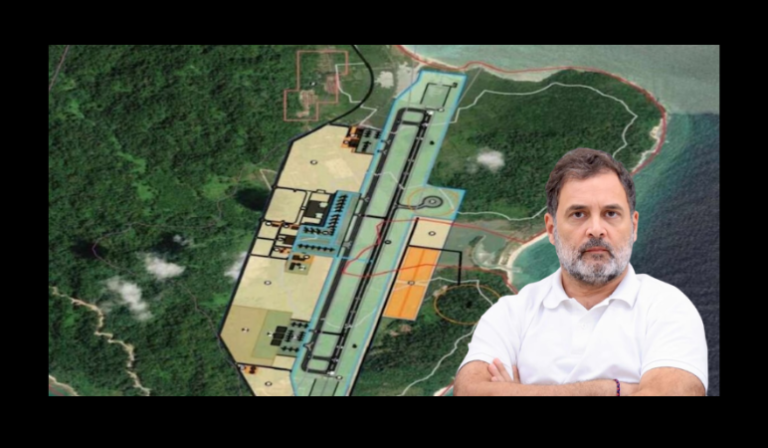
And that is exactly where The Great Nicobar Project comes into play. An idea designed to transform the island into a sustainable, green, global economic, and strategic hub but disguised to block China from overpowering it, in case of a warring situation.
This project is much more than what it projects at face value.
The Great Nicobar Project, is a Rs. 92,000 crores, strategic project undertaken by the Central Government of India. It is supposed to span over 166 sq. km, of Great Nicobar’s 910 sq. km area. The GNI project aims to build an International Container Transshipment Terminal (ICTT), a greenfield international airport, a township and a gas-solar power plant. It was launched by NITI Aayog in 2021, and is said to be implemented by ANIIDCCO (Andaman and Nicobar Islands Integrated Development Corporation Limited).
The project aligns well with the Indian Maritime Vision 2030 and a key project under the Amrit Kal Vision 2047.
A less understood aim of the project is that, the government wishes to create India’s Hong Kong. Hong Kong is a centre of trade, finance, technology, infrastructure as well as a strategic location upon which the entire world is dependent. It is said to be a springboard to China and surrounding markets. Overseas companies are attracted to Hong Kong due to the role it plays as a connector between mainland China and other key cities.
Moreover, it has become a hub of regional research and development within emerging fields spanning from deep tech to sustainability. Lastly, its ability to carry out favourable trade policies makes it an attractive trade and business destination for countries from across the world.
This ambition has led India to build the island into a sustainable, green, global economic, and strategic hub by developing an International Container Transshipment Terminal (ICTT), a greenfield international airport, township, and power plant.
Significance of Malacca Strait
The Great Nicobar island is 1200 km away from the Indian coast, which raises an important question; why is India constructing a transshipment port so far away in Andaman and Nicobar Islands, when alternately it can be constructed right on the coast of Bay of Bengal.
The Great Nicobar Island is strategically located at an equal distance from Colombo and Singapore and very close to the East-West shipping corridor. This corridor connects East Asian exports to the Indian Ocean, Suez Canal, and Europe which passes from just south of the Island. Therefore, this route has the ability to significantly reduce transport time and costs, enhance market access for remote regions, and strengthen regional geopolitical and economic integration.
This East-West shipping corridor passes through the Malacca Strait. This strait proves strategic and crucial as it is the shortest maritime route between the Indian and Pacific Oceans. Thus, it controls 40% of global trade, 25% of oil, and integral energy supplies for East Asian countries like Japan, China, South Korea as well as the Middle East economies. Therefore, its significance arises from being an economic lifeline and strategic chokepoint for global energy security and supply chains.
Approximately 60% of India’s seaborne trade and almost all of its LNG (Liquified Natural Gas) imports pass through the strait, which is also a choke point for Chinese shipping which makes it all the more strategically sensitive.
Maximum Chinese Sea borne trade passes through this strait. The entire South and South-Eastern side have Chinese industrialization, ports, and population. Thus, it becomes the world’s busiest trade route and that is why the Great Nicobar island is of strategic importance.
By constructing a container port on this island, it would give India a supreme hand in participating and controlling global shipping trade. This way, India would be able to challenge the Singapore port, second to Hong Kong port.
Since the island is the southernmost tip of India, it is closest to the Strait and it is this strategic proximity why we are building a transshipment port here.
National Security- Strategic Importance of the Great Nicobar Project
International politics is driven by trade wars these days. Despite a modern touch to the marathon between countries, no state can ignore its military capabilities. Especially, in the background of a volatile world ignited by the threat of nuclear weapons, such that even deterrence seems like a farfetched idea, India cannot ignore developing its own.
Presently India is threatened by China from almost all sides. It surrounds India from the Gwadar Port (Pakistan), Hambantota Port (Sri Lanka), Kyaukpyu Port (Myanmar) as well as the Coco Islands, where Myanmar’s sovereign territory has increasingly been utilized by China for maritime surveillance infrastructure. India faces pressure from China in the Himalayas too. This is disguised as the String of Pearls Strategy, which revolves around creating a naval ring around countries like India.
India has responded with equal strength via the Double Fish Hook Strategy where it controls maritime and trade routes of Duqm Port (Oman), Reunion Islands (France), Lakshadweep (India), Mauritius which constitute the Western Hook, and the Eastern Hook comprising of the Andaman and Nicobar (India), Sabang Port (Indonesia), Cocos (Keeling) Islands (Australia) and Diego Garcia (USA).
The Great Nicobar Project is a part of this very strategy. The island acts as an anchor point. The Strait of Malacca joins the Bay of Bengal to the South China Sea, which gives India the perfect position to obstruct China’s trade and a definite dent on its revenue generation.
Defence disguised as trade? Rather, trade is the new defence today.
The Andaman and Nicobar Islands act as India’s first line of maritime defence. Secondly, they share sea boundaries with Myanmar, Thailand, Indonesia, and Bangladesh.
The proposed airport in the project, would be designed to handle larger military aircraft and help reduce response time for defence operations. The otherwise nearest major airport is Veer Savarkar International Airport, which is 500 km away. This limits quicker deployment and response time. The airport is said to support both civilian and strategic operations, which would strengthen India’s presence in the Indian Ocean.
Thus, India has leverage against China. But at the cost of the ecology?
Is the Great Nicobar Project truly sustainable?
Sonia Gandhi showed staunch criticism against the implementation of this project where she stated in her article published in The Hindu on September 10, 2025. She rightfully reasoned that; the island consists of 2 tribes, namely, the Nicobaris and Shompens. The project can lead to the destruction of an entire human settlement. Secondly, the ecological front will severely decline. Animal displacements are bound to happen, especially of the ‘Nicobar Long Tailed Macaque’, tortoises, etc.
Therefore, Sonia Gandhi’s criticism cannot be denied completely. If it is harmful to the environment, it causes a threat to human existence as well as extinction of rare species. It displaces the two tribes, Nicobaris and Shompens, which goes against the basic fundamental and human rights of individuals of these tribal communities.
Secondly, if it is only to be transformed into a trade and military base, why then does it involve the construction of shopping and entertainment centres, luxury tourism infrastructure, and residences for a population of 3,50,000. Currently, it holds 8,000 people, and would involve a 4000% increase for the same.
Now the Indian government’s push for the project is driven by a strategic ambition to recapture 75% of India’s transhipped cargo currently handled by foreign ports such as Colombo, Singapore, and Klang. The vision is to transform the island into a free-trade zone akin to Hong Kong or Singapore to attract multinational corporations. But will conservation efforts truly work in India’s favour?
The layout of the site has been prepared while keeping in mind the nature of terrain and drainage patterns. The infrastructural plan helps limit the changes to the existing landform patterns. Thus, the project does aim for a sustainable design and construction costs.
But is that enough?
Currently, we are our own enemies. The Supreme Court’s decision on mining activities in the Aravalli range in recent years has been one of the biggest setbacks to the protection of India’s ecology. Do we truly take a stand for conservation efforts?
For a moment, we can consider the implementation of this project. But when previous efforts haven’t been maturely taken, such as decisions by state governments in the South to cut away entire forests or mining away the mountain range that basically forms the origin of North India, it seems like a farfetched idea that this project will garner a different outcome.
Conclusion
Right now, India is facing a dilemma. While on one hand, the GNI project will shoot up India’s position in matters of trade as well as defence standpoint, it also equally if not more, affects the ecology.
When the fundamental rights of the communities are affected, in the name of defence, both become equally imperative. While our defensive capabilities affect the greater part of the population as compared to the percentage of livelihood affected, is it still worthy of a differential ratio?
Yes, development for one may not be development for another. So then why has India rarely ever taken groundbreaking environmental efforts? Because in a volatile world like today, when it truly becomes necessary to add foundational changes to India’s defence against the strongest bullies of the world, our own conditions can become our enemies.