

On the dreaded day of April 22, 2025, a newlywed couple from Haryana, Indian Navy Lieutenant Vinay Narwal and his wife Himanshi Narwal, were on the streets of Baisaran Valley, Pahalgam celebrating their honeymoon. Suddenly, they were approached by gunmen, who were later identified as Pakistan-sponsored terrorists. They asked the Lieutenant if he was Hindu before shooting him in cold blood. This was just four days after their wedding. Lt. Vinay Narwal died on the spot.
This was the story of just one out of all 26 innocent civilians killed in the attack. Victims were killed based on their religious affirmation. A popular tourist meadow turned into a killing field. Militants picked out Hindus and shot 25 Hindu men. Even a local Muslim was killed when he tried to help.
This was one of the deadliest militant attacks in Indian-administered Kashmir since 2019. But simultaneously, India finally decided that a counter attack was necessary to show Pakistan that India’s pacifist stance should not be taken for granted.
Operation Sindoor: The Counterattack
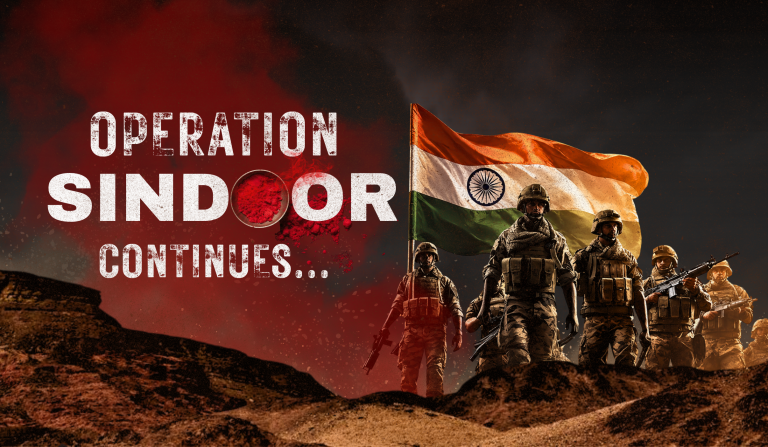
On May 7, 2025, around 1 am, missile fires illuminated the skies over Pakistan in what India described as Operation Sindoor, targeting the terrorist infrastructure of Pakistan. Two of the terrorist organizations attacked in this operation were Lashkar-e-Taiba and Jaish-e-Mohammad. Nine launchpads of those organizations were destroyed. India’s Defence Minister Rajnath Singh indicated that at least 100 militants were killed in these operations.
Pakistan presented a very different account of what happened. They stated that there were deaths of civilians and damage to mosques at six sites across Pakistan. Jaish-e-Mohammed’s leader Maulana Masood Azhar stated that 10 family members and 4 aides were killed in the Indian airstrike on the headquarters.
Pakistan’s Unprovoked Escalation
On 10 May, Pakistan launched an operation called ‘Operation Bunyan-un-Marsoos‘ to attack various Indian bases as retaliation for prior Indian artillery fire. Pakistan also intensified artillery shelling in Poonch – an area that had not witnessed this scale of attack in decades.
Along with this, Pakistan’s artillery fire hit the Shambhu Temple in Jammu, a Gurudwara within Poonch and several Christian covenants to help India create communal friction.
India responded by expanding the scale of military options. Satellite imagery, drone footage and damage assessments later confirmed strikes on Pakistani radar stations, command centres and key airbases.
Through this conflict, India exposed major weaknesses in Chinese military equipment to the entire world. Pakistan imports 81% of its weaponry from China. 63% of China’s global exports are to Pakistan. The bilateral trade of the two countries is about $5 billion in 4 years. The arms trade included a fully integrated Chinese combat ecosystem. They traded HQ-9 air defense systems, J-10C fighters, JF-17, advanced radars (YLC-8E anti-stealth), AWACS + Chinese-linked data systems, combat drones (Wing Loong series), ZDK-03 airborne early warning aircraft and the BeiDou satellite navigation system.
On May 7, Chinese military hardware faced its first real credibility test when India struck first in the history of its military actions. India launched an Israeli-origin HARPY loitering munition which detects the radar emission. It didn’t need coordinates, only radio frequency signatures. It locked onto the signal, flew directly into the radar system and destroyed the HQ-9 fire control unit. For the first time, Chinese air defense systems failed under real combat conditions.
After receiving these embarrassing blows, at approximately 5 p.m IST on 10th May, 2025, the Pakistani DGMO, Major General Kashif Abdullah, made direct contact with the Indian DGMO, Lieutenant General Rajiv Ghai, through a hotline and a ceasefire was agreed upon. But even after the ceasefire, Pakistani UAVs and drones continued attempting incursions into Indian territory, albeit all such incursions were met with successful interception by Indian Forces.
A Wider Strategy
Operation Sindoor wasn’t merely a military operation. India launched non-kinetic actions as part of its effort to attack Pakistan. Following its attack on Pakistan during Operation Sindoor, India suspended the Indus Waters Treaty (1960) and shall reconsider the agreement only after Pakistan provides credible evidence against cross-border terrorism. Pakistan will suffer major consequences as a result of losing access to the Indus River System. The Indus River System provides 80% of Pakistan’s 16 million hectares of irrigated agricultural land and 93% of Pakistan’s total water supply, supporting 237 million people and generating 25% of Pakistan’s GDP.
There was urgent international attention for the conflict with Saudi Arabia’s Minister of State for Foreign Affairs flying to Pakistan, UK Foreign Secretary talking with both counterparts and UN asking for maximum restraint. President Trump claimed he was responsible for negotiating the ceasefire; however, India claimed it occurred between the two countries directly.
Lessons and Legacy
Operation Sindoor is one of the most far-reaching and bold military operations undertaken by India against Pakistani targets since the 1971 Indo-Pakistani War that ended in the establishment of Bangladesh. It highlights that India had not relied on a single arm of power. Instead, India combined intelligence, surveillance, precision strikes, loitering munitions and integrated command systems into a single coordinated operation.
Even foreign military think-tanks concluded that India achieved air superiority by degrading key Pakistan assets and imposing costs with controlled escalation. When Defense Minister Rajnath Singh described Operation Sindoor as ‘tech-driven military might’, he was describing it as a transformation as opposed to a continuation in military strategies. This structural change was visible in the Ashni Platoons embedded across infantry battalions, the Eagle in the Arm“ doctrine and drone training becoming standard across units and services.
The Founder of Armory, Mr. Amardeep Singh, alludes that the question is no longer whether India can build indigenous systems, but whether it can build them fast enough. And the state has proven it can, through emergency procurement of 6 fast-tracked acquisitions, FY27 defence budget rising 15.2% to ₹7.85 lakh crore, over ₹1.11 lakh crore being earmarked for domestic procurement and counter-drone systems being placed at the centre of priorities. Startups like Armory are no longer waiting for procurement cycles. They are working alongside the armed forces through testing, refining, deploying.
The lesson of all this is quite canonical. Operation Sindoor has established a norm for how to handle a future Indo-Pakistani crisis. India will now have both the abilities, offensive and defensive, to dominate whatever situation arises and will be prepared to use its power, if provoked. Prime Minister Narendra Modi termed the operation a new form of justice, stating that India would no longer react to terrorism but would rather work to eradicate it. The attack at Pahalgam essentially altered the equation which put gears into motion to execute Operation Sindoor.
Conclusion
Operation Sindoor did not just serve as a military response, it signified a permanent shift in the rules of engagement between India and Pakistan. For years, Pakistan engaged in cross-border terrorism and violence through an ambiguity created by their ability to use nuclear deterrence. On May 6–7, 2025, the shield of nuclear deterrence was broken for the first time.
The 26 lives lost in Baisaran Valley cannot be restored by missile strikes or ceasefire agreements. But Operation Sindoor achieved a fundamental reset of deterrence, of doctrine, and of the message India sends to those who would exploit its borders.
One year since Operation Sindoor, the dust has settled but the echoes have not. Military doctrines have been rewritten, alliances recalibrated, and the doorway for Indian military action redefined in ways that will shape every crisis to come. What was once unthinkable; Indian missiles striking deep inside Pakistani territory; is now documented history.
About the Author

Manjyot Kaur
Manjyot Kaur is an analyst specializing in International Relations, with expertise in international security, foreign policy, political economy, and global governance. Over the past three years, she has developed a rigorous engagement with IR discourse, translating complex geopolitical dynamics into incisive, evidence-based analytical writing.