

China’s Semiconductor Drive and Military Ambitions
Introduction
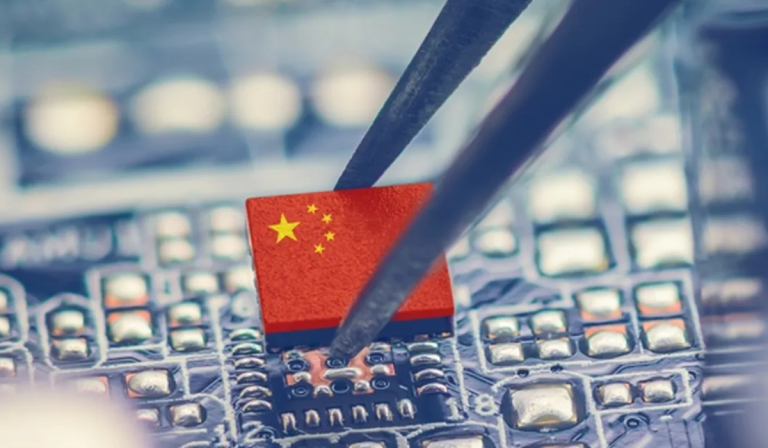
Semiconductors have emerged as the backbone of modern technology. They have enabled advancements in artificial intelligence, communication, and defence systems. Control on semiconductor production now shows the economic competitiveness as well as national security. China’s struggle for semiconductor power and technological advancements signifies the goals of the nations in the industry. China still relies on imported chips. These imported chips are used for their advanced artificial intelligence, 5G, and defence systems. Understanding this vulnerability, Beijing has made semiconductor self-sufficiency as a national priority (Acclime China, 2024).
In the last few decades, China has launched many policies such as Made in China 2025, and China Standards 2035 to build their own semiconductor industry. This push shows the nation’s broader military modernization strategy and not just the economic and industrial objectives. Under the Military-civil Fusion (MCF) policy, civilian semiconductor innovations are directed towards the defence applications. This powers their advanced weapon system, artificial intelligence and surveillance technologies (ARC Group, 2022).
However, China’s rise has been perceived as a concern for the United States and its allies as it has executed export controls, restricted sales of advanced chips etc to dominate the industry.
China’s Semiconductor Evolution
China’s semiconductor evolution began in the 1980s with ambitious dreams but limited capabilities. It began with China recognizing the importance of integrated circuits for national modernization. Due to lack of technology, talent and overreliance on imported equipment, the nation’s efforts were hindered. Through the 1990s and the 2000s their progress was slow. China became known as the world’s electronics factory—collecting devices but not producing the chips that powered them. However, advanced microprocessors were still controlled by the U.S., Japan, South Korea, and Taiwan.
Recognising this technological backlog, Beijing launched several state-led initiatives to encourage domestic innovation. In 2014, the National Integrated Circuit Industry Investment Fund also known as the Big Fund was established. Under the plan billions of dollars were invested in domestic chip fabrication and equipment manufacturing. Later it was reinforced under the Made in China 2025 plan. It identified semiconductors as a core of strategic industry and are essential for national security and industrial modernization. Companies like Semiconductor Manufacturing International Corporation (SMIC), Huawei’s HiSilicon, and Yangtze Memory Technologies Co. (YMTC) were the champions of this vision. China continued to depend on the imported lithography tools and Electronic Design Automation (EDA) software despite their progress in the logic chips and memory chips. These tools are essential for advanced chip manufacturing and yet China’s industry continued to depend on imports (John VerWey, 2019).
U.S. imposed sanctions on Huawei and SMIC in 2019 and 2020 respectively. It revealed how deeply China is depended on foreign technology. The sanctions, intended to limit China’s ambitions, unintentionally triggered a surge in its investment in research, education, and innovation. The lesson was clear — Nations cannot be fully become independent in the modern era without control over semiconductors. The current state of China’s chip industry exposes its historical dependence but also reveals a clear plan to become self-sufficient (American Affairs Journal, 2024).
The Strategic Imperative: Why Semiconductors Matter for the Military
Semiconductors have become the backbone of the 21st century warfare — from drones and missiles to satellites and supercomputers. They are essential for advanced defence systems. Control over advanced chip design and manufacture provides the most important strategic advantage today. For China, this realization has made semiconductors a matter of national defence and not just economic ambition.
China’s Military-Civil Fusion (MCF) policy has strengthened ties between its private tech companies and the People’s Liberation Army (PLA). This enabled the continuous flow of technology, resources, and talent between the civilian and military sectors. For example, chips made for AI systems and smartphones are now used in military surveillance, automated targeting, and facial recognition networks. Thanks to these technologies, China can now monitor threats, analyse real-time combat data, and even predict enemy movements with remarkable accuracy. Semiconductors also power China’s most advanced weapons. Hypersonic weapon systems require incredibly fast processors to manage their immediate navigation and control functions. Satellites equipped with specialized chips enhance communication, positioning, and espionage capabilities. Progress in quantum computing and AI chips is improving China’s cyber warfare capabilities. It facilitates advancements such as quicker encryption, stronger resistance to hacking and greater information dominance (Cheung, Tai Ming, 2022).
China’s leadership need to understand that chips are essential for modern-day armed forces. Every new and advanced weapon system rely on precision made available through semiconductors. So, China’s pursuit of semiconductors is motivated by aspirations beyond trade and technology. This has led chips to become the crucial components of modern conflict, serving as the “quiet champions” in the contemporary digital age. They are significant in achieving national objectives like technological sovereignty and redefining global power dynamics (Francesca Ghiretti, 2023).
U.S.–China Tech War: Sanctions and Reactions
The growing rivalry between the U.S. and China has made the semiconductor industry a major area of strategic conflict. Washington has imposed several export restrictions on China’s to contain the nation’s technological rise. It targets the key sectors of its chip industry. In 2019 the U.S. placed them on the Entity List. Hence, Huawei and SMIC were cut off from important chip supplies and manufacturing equipment. Later, the restrictions were increased to limit the export of high-performance AI processors and the important machinery used in the production of sub-10-nanometer chips.
The CHIPS and Science Act of U.S., in 2022 implemented policies. Those increased the process of technological separation between U.S and China. It offered massive subsidies to U.S chipmakers. However, it excludes firms from increasing advanced manufacturing in China. Also, Washington pressured allies such as Japan and the Netherlands to adopt similar regulations. This limit China’s access to international supply chains for manufacturing equipment from companies like ASML and Nikon.
Beijing has responded swiftly by adopting what experts refer to as “chip nationalism.” It doubled the funding for domestic production through the Big Fund. This prioritized the local R&D and replaced the foreign technologies. It also restricted the exports of rare minerals such as gallium and germanium. Both of them are essential for global chip production.
These sanctions restricted China’s growth at first. But later they proved to be a boon by increasing China’s resolve for self-reliance. Research institutions, engineers, and private companies are now uniting to innovate domestically. Beginning as an economic pressure policy, the situation is now powering a new phase of development in China’s semiconductor and military-industrial complex, fuelled by requirements, pride, and strategic goals.
Global Implications: Security and Strategic Balance
China’s rise in semiconductor industry is far beyond technology. It has significant consequences for international security and the balance of global power. If China achieves full control over chip production it will no longer depend on western suppliers. It gives it a stronger hand in both military and economic affairs. And these semiconductor chips are the foundation of advanced military systems, artificial intelligence, and surveillance networks. Greater technological independence leads to increased strategic strength because it reduces dependence on other countries for essential technologies. This is crucial for national security.
Taiwan lies at the centre of the semiconductor landscape. The world’s most advanced chips are designed in TSMC. Taiwan’s factories produce most of the world’s advanced semiconductors. This makes them vital to global stability. For China, gaining control over Taiwan would not only fulfil political ambitions but also grant access to unmatched technological capabilities. But for U.S. and its allies, protecting Taiwan is essential to safeguard the semiconductor industry. As a result, the Taiwan Strait is now considered one of the most critical flashpoints for potential international conflict.
Meanwhile, China’s increasing presence in cybersecurity is raising concerns. Risks of surveillance and data manipulation is more for nations that use Chinese chips for communication. This fear has already pushed the U.S., Europe, Japan, and India to form new alliances. This will strengthen their chip supply chains and reduce their reliance on China. These include the U.S. CHIPS Act, the EU Chips Initiative, and the India Semiconductor Mission, to reduce dependence on any single nation.
The global consequence is a slow but visible technological split. The world is splitting into two ecosystems — one orbiting Washington, the other Beijing. This digital divide threatens the open, interconnected internet once imagined in the early 21st century. The semiconductor race is thus no longer about faster processors; it is about who writes the code of global order (Michael Sobolik, 2024).
Challenges and Bottlenecks
Despite China’s determination to achieve semiconductor self-sufficiency, its path to self-reliance remains obstructed by several serious technological and structural challenges. The most significant challenge is the access to the advanced lithography technology, especially EUV machines. These are indispensable for fabricating cutting-edge chips below 7 nanometres. These machines are produced by ASML in Netherlands. U.S. export controls have made sure that China remains constrained to these systems. Thus, Chinese chipmakers like SMIC are lagging behind to produce 14nm or larger nodes. This inability of China limits their progress in producing chips suitable for advanced AI and defence applications.
Another Equally critical challenge is China’s dependence on foreign Electronic Design Automation (EDA) tools. Despite their efforts to have domestic alternatives, the global EDA ecosystem is controlled by several American firms. Their software is crucial for chip layout, simulation, and verification. Without understanding these design tools, even the most sophisticated manufacturing equipment cannot make the cutting-edge chips. This effectively restricts China’s innovation ceiling (Wenjie Zhang, 2019).
China also struggles with talent shortage and R&D capability gap. Its universities produce large numbers of engineers. But a few of them only have the expertise needed to design and manufacture these advanced chips. Moreover, an ongoing brain drain—where Chinese scientists prefer to work in the U.S., Taiwan, or Europe—drains the nation’s intellectual capital at a critical time.
Despite massive state investment, exceeding $150 billion since 2015 in chip research, the rate of genuine innovation remains moderate. Various factors such as corruption, misuse and mismanagement of funds, and bureaucratic inadequacy has led to constant failures of projects. The 2023 investigation into the “Big Fund” revealed misuse of capital and favouritism over merit-based innovation.
In short, China’s semiconductor ambition is a contradiction: massive financial and political backing exists but technological independence remains vague. The pace of innovation remains slower than expected. Without reforming internal inefficiencies such as its funding mechanisms, investing in human capital, and building credibility in innovation, nation’s dream to control semiconductor industry will remain strained.
The Road Ahead: Future Prospects
China’s semiconductor industry is now aiming to create its own original innovations in the semiconductor industry. Nation recognised the increasing gap in advanced nodes. Beijing is using a flexible approach with two parallel methods that is emphasizing on AI chip development and investing in domestic lithography and material research. The immediate priority is to focus on increasing domestic manufacturing capabilities for semiconductors at and above the 28-nanometer node as these chips are essential for critical applications in the automotive, telecommunications, and defence industries. This focus on practical utility could provide short-term stability and reduce foreign dependency. Hence it ensures continuity amid sanctions and provides a foundation for sustainable technological independence.
The AI frontier presents a significant opportunity for China. Major domestic technology firms, including Baidu, Tencent, and Huawei, are actively developing their own personalized AI accelerators and neural processing units specifically made for machine learning tasks. By integrating AI-specific chips into domestic supercomputers and military systems, China can partially avoid the limitations of its lagging foundry capabilities. The software-hardware co-optimization involves achieving performance improvements primarily through algorithmic efficiency and innovative design at the system level, rather than relying solely on the traditional method of shrinking transistor sizes.
Meanwhile, domestic lithography research is also progressing under research institutions and firms like SMEE (Shanghai Micro Electronics Equipment). They are working towards producing practical Deep Ultraviolet (DUV) and possibly next-generation lithography tools using domestic optics and lasers. Combined with innovations in photoresists and silicon wafer purification, China is gradually building an independent production ecosystem—though still heavily reliant on foreign precision optics.
In the coming years, China’s breakthrough potential depends on institutional reform. The success of its chip ambitions will depend not just on technological progress, but also on greater responsibility in research and development, reducing corruption, and promoting new ideas that aren’t solely reliant on government funding.
While China might not overtake the United States in the future, it is on track to become strategically self-reliant. That means it will have enough capacity to meet its national security requirements and sustain major domestic industries. Rather than pursuing global dominance, China is focused on achieving self-reliance through a domestic semiconductor industry that is safe from foreign coercion and sufficient for its military modernization needs (Euronews Business, 2024).
References
-
- Acclime China, “China’s Semiconductor Industry: The Path to Self-Sufficiency,” Acclime China, 2024, https://china.acclime.com/news-insights/semiconductor-industry/.
-
- ARC Group, “China’s Semiconductor Industry: Current Development and Complications,” ARC Group, 2022, https://arc-group.com/china-semiconductor-industry/.
-
- John VerWey, “Chinese Semiconductor Industrial Policy: Past and Present,” United States International Trade Commission, 2019, https://www.usitc.gov/publications/332/journals/chinese_semiconductor_industrial_policy_past_and_present_jice_july_2019.pdf.
-
- Cheung Kong Graduate School of Business (CKGSB), “Chipping Away: China’s Semiconductor Struggles,” CKGSB Knowledge, 2023, https://english.ckgsb.edu.cn/knowledge/article/chipping-away/.
-
- American Affairs Journal, “The Evolution of China’s Semiconductor Industry Under U.S. Export Controls,” American Affairs Journal, 2024, https://americanaffairsjournal.org/2024/11/the-evolution-of-chinas-semiconductor-industry-under-u-s-export-controls/.
-
- UC Institute on Global Conflict and Cooperation (UCIGCC), “China’s Evolving Semiconductor Strategy,” UCIGCC Blog, 2024, https://ucigcc.org/blog/chinas-evolving-semiconductor-strategy/.
-
- Cheung, Tai Ming. “Innovate to Dominate: The Rise of the Chinese Techno-Security State.” Brookings Institution, 2022. https://www.brookings.edu/articles/chinas-civil-military-fusion-strategy/
-
- Francesca Ghiretti, “The Dragon’s Tech Ambition: China’s Pursuit of Semiconductor Power,” Journal of European Integration, Taylor & Francis Online, 2023, https://www.tandfonline.com/doi/full/10.1080/01402390.2023.2164852.
-
- Michael Sobolik, “China’s Defiant Chip Strategy,” Foreign Policy Research Institute (FPRI), 2024, https://www.fpri.org/article/2024/06/chinas-defiant-chip-strategy/.
-
- Microchip USA, “Semiconductors: A National Defense Priority,” Microchip USA, 2024, https://www.microchipusa.com/industry-news/semiconductors-a-national-defense-priority.
-
- Wenjie Zhang, “Semiconductors as Strategic Assets: Lessons from China,” World Scientific Journal of Infrastructure, Policy and Development, 2019, https://www.worldscientific.com/doi/abs/10.1142/S237774001950012X.
-
- Danish Institute for International Studies (DIIS), “China’s Response to the U.S. Tech War,” DIIS Research Report, 2023, https://www.diis.dk/en/research/chinas-response-to-the-us-tech-war.
-
- Oleg Lukin, “China’s Semiconductor Policy: Between Innovation and Dependence,” New Economy Association Journal, 2022, https://ideas.repec.org/a/nea/journl/y2022i55p212-217.html.
-
- SEMI International, “Challenges and Opportunities in China’s Semiconductor Industry,” SEMI, 2023, https://www.semi.org/en/challenges-and-opportunities-china-semiconductor-industry.
-
- The Waves, “China’s Semiconductor Independence Is Prematurely Caught,” The Waves Journal, 2022, https://www.the-waves.org/2022/11/04/chinas-semiconductor-independence-is-prematurely-caught/.
Euronews Business, “China’s Semiconductor Production Challenges Could Be a Boon for Europe,” Euronews Business, 2024, https://www.euronews.com/business/2024/03/15/chinas-semiconductor-production-challenges-could-be-a-boon-for-europe.