
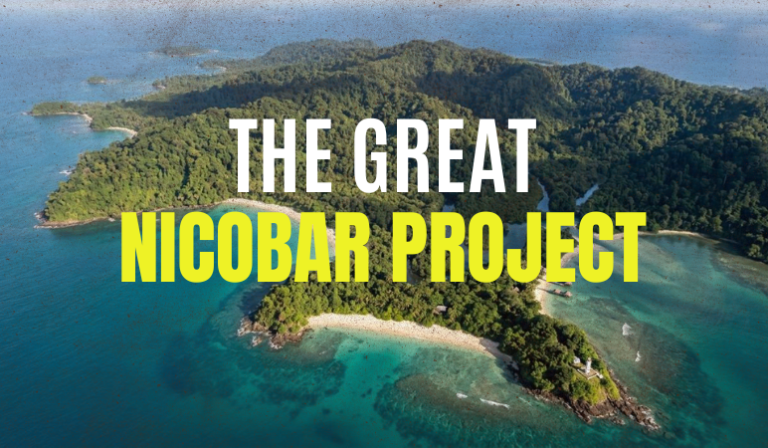
The Great Nicobar Project was launched in 2021 by NITI Aayog. It focuses on expanding India farther in the Andaman Sea and Southeast Asia. Its main objective is to grow port development while making sure the safety of the environment and the protection of indigenous people. It also aims to ensure that the development on the island is sustainable while still aligning with national interests. This is to be achieved by turning Great Nicobar into a maritime and economic hub which will help India reduce its dependency on foreign transshipment ports. The project includes an International Container Transshipment Terminal (ICTT) with a capacity of 14.2 million TEU (Twenty-Foot Equivalent Unit), a Greenfield International Airport for 4000 Peak Hour Passengers (PHP), a 450 MVA (Megavolt Ampere) gas-and-solar-based power plant and a new township spanning 16,610 hectares. The value of the project lies between ₹75,000-81,000 crores.
The Malacca Advantage
For India, the Great Nicobar is not just a fancy tourist destination, it is possibly the most gifted geographical piece of territory India possesses. The island strategically overlooks one of the world’s busiest maritime chokepoints, located just north to the Strait of Malacca. Nearly one-third of all global shipping passes through this corridor. This includes oil, liquefied natural gas and other trillions of dollars worth of goods.
The Great Nicobar island also has its advantages because of its accessibility to other ports. It is situated almost equidistant from Singapore, Port Klang in Malaysia and Colombo in Sri Lanka. These three are Asia’s most critical and busiest ports. The development of Naval bases, surveillance systems and transshipment facilities will establish India’s dominance at this critical intersection of Indo-Pacific trade.
For decades, India has looked past these advantages and ignored the Great Nicobar. The island has remained underdeveloped, sparsely populated and strategically neglected. Meanwhile, the surrounding waters have grown increasingly competitive. China’s naval presence has aggravated and other foreign submarines also show presence in the waters. The Indo-Pacific region is growing rapidly in 21st century geopolitics.
However, the Great Nicobar project is finally waking up India to its owned territory’s potential. The aims of building the International Container Transshipment Terminal, the Greenfield International Airport and the development of the Andaman and Nicobar tri-service command shall transform the island from a passive and overlooked land to an active strategic asset.
The Chinese Encirclement
While India was passive on the matter of Great Nicobar, China has been highly active in the region. China has systematically installed ports, naval agreements and infrastructure investments in a geographical position which encircles the Indian subcontinent. Analysts refer to this strategy as the ‘String of Pearls’. The strategy is quite detrimental to India: control the ports surrounding India and then get access to India’s strategic plans for the region.
In Sri Lanka, there has been an installation of the Hambantota port by a Chinese state enterprise. Taking advantage of Colombo not being able to repay a Chinese debt, they secured themselves a 99-year lease and placed their facility less than 300 kilometres from the Indian coast. In Pakistan, the Gwadar port has been developed under the China-Pakistan Economic Corridor. This port also gives the PLA navy access to the doorway of the Persian Gulf. Chinese investment traces can also be found in Myanmar, Djibouti, Bangladesh, the Maldives and Tanzania.
This has resulted in a Chinese strategic encirclement around the Indian subcontinent. Even though it is not a naval siege, it could be one during a crisis. Each Chinese port investment gives the PLA navy options to occupy Indian territory. The development aims in the Great Nicobar Project is the only counter-move India can afford in this situation.
Why India cannot Afford to wait
The riskiest mistake in India’s strategic thinking is to adopt a ‘we’ll do it eventually’ approach. Delay in geopolitical decisions regarding a situation where China is overtaking will harm India in the longer run. Every year the Great Nicobar project is delayed is another year where China can strengthen their presence in the Indian Ocean and become harder to counterbalance. The window in which India can establish its dominance in the eastern Indian Ocean is slowly closing.
Let us look at the timeline. In 2010, China’s naval presence was minimal. There were reports of only anti-piracy patrols and occasional port visits. Seemed like nothing much at face value. However, in 2026, PLA navy vessels conduct regular patrols in the region. There have even been traces of China in the Bay of Bengal where they have negotiated access to facilities. This was possible because of the foundation they set in 2010. And the foundation they are setting now by building ports, undersea cables and refuelling agreements, will add value to China’s future strategic plans.
The cost of delay is also high realistically. It will take several years to develop and construct all that will be required to implement the Great Nicobar Project and enable continued operations by wherein; the Port can handle Aircraft Carriers & their groupings, there is adequate ramp space at the Airstrip, there is a Communications & Logistics Support system available to maintain a continuous Military presence. Even if the construction began today and at full pace, the project would likely not become operational till mid 2030s. By then, China’s naval presence will be even more significant than it is today.
Along with a strategic interest, there lies an economic opportunity for India as well. Right now, many ships carrying goods from India’s east coast don’t stop at Indian ports because they aren’t big or advanced enough. Instead, they go to ports of Singapore or Sri Lanka. A new port would keep that business and money in India. This would also enable Indian companies to ship their products overseas in a much cheaper and faster way. Usually military and economic goals are separate. Here, we get both the advantages combined through the development of just one port. India overlooking this advantageous opportunity would be a huge mistake as the area is already contested with Chinese rivals.
Conclusion
The Great Nicobar is a “must” for India’s national security. India cannot afford to ignore the island because China is increasingly becoming active in the Indian Ocean. Great Nicobar is India’s best “chess piece” to push back. Leaving it underdeveloped is like surrendering a key strategic asset, and this would hand China its greatest advantage against India.
However, the manner of the development matters too. However, the manner of development is equally important. The island’s unique ecology and indigenous communities must not be sacrificed merely to build military infrastructure. Destroying its biodiversity or displacing local populations would severely damage India’s global image and invite prolonged legal challenges. If you damage the things that are most special about the land, you will lose your ability to defend it.
Strategically, doing things the right way makes more sense than trying to take shortcuts in the name of ecological and human rights issues; taking these types of shortcuts will likely result in ongoing legal action as well as international condemnation. When you take the time necessary to perform due diligence, with reference to oversight, and comply with strict regulations, the entire project becomes stronger and will make it harder for skeptics to slow down or prevent the project from being successful.
India needs to prove it can be a global power that executes bold decisions responsibly. Bold moves shouldn’t require sacrificing your values or the environment. India needs to master the art of balancing its national interests along with taking responsibility for no damage to the island.
About the Author

Manjyot Kaur
Manjyot Kaur is an analyst specializing in International Relations, with expertise in international security, foreign policy, political economy, and global governance. Over the past three years, she has developed a rigorous engagement with IR discourse, translating complex geopolitical dynamics into incisive, evidence-based analytical writing.