

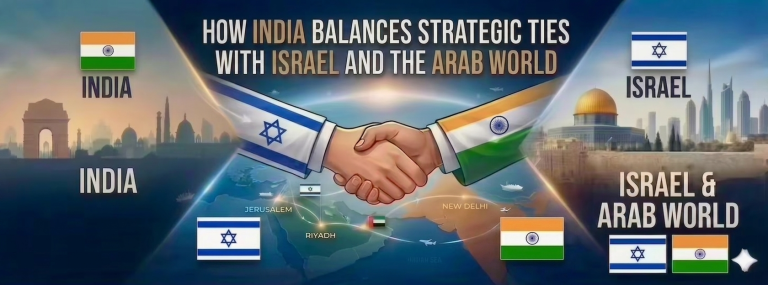
Introduction: India’s Strategic Balancing Act in West Asia
West Asia has emerged as one of the most strategically significant regions shaping India’s foreign policy in the twenty-first century. The India West Asia Policy Strategic Balance reflects New Delhi’s effort to deepen strategic partnerships while safeguarding its energy security, economic interests, and diplomatic flexibility across the region. The ongoing Israel–Hamas conflict, recurring tensions between Israel and Iran, maritime security challenges in the Red Sea, and the growing involvement of global powers have intensified geopolitical competition across the region. For India, these developments present a complex diplomatic challenge.
Israel has become a key partner in defence, intelligence, agriculture, and technological innovation, while the Arab world remains indispensable for India’s energy security, trade, investment, and the welfare of millions of Indian expatriates living in the Gulf.
Rather than treating these relationships as mutually exclusive, India has adopted a pragmatic approach rooted in strategic autonomy and multi-alignment. This policy enables New Delhi to strengthen defence cooperation with Israel while simultaneously expanding economic and diplomatic engagement with major Arab partners such as the United Arab Emirates, Saudi Arabia, Qatar, and Oman. India’s evolving engagement reflects a broader shift from ideology-driven diplomacy to interest-based statecraft.
This article explores how India has balanced its strategic ties with Israel and the Arab world through defence cooperation, economic partnerships, and calibrated diplomacy, while assessing the opportunities and challenges of sustaining this delicate equilibrium amid an increasingly volatile regional order.
From Ideology to Pragmatism: The Evolution of India’s West Asia Policy
India’s engagement with West Asia has undergone a significant transformation over the past seven decades. In the decades following independence, New Delhi’s policy was largely shaped by ideological considerations, including its support for anti-colonial movements, commitment to the Palestinian cause, leadership within the Non-Aligned Movement (NAM), and the need to maintain strong ties with Arab nations that were critical to India’s energy security and expatriate workforce. Although India formally recognised Israel in 1950, full diplomatic relations were established only in 1992, reflecting the cautious approach adopted during the Cold War.
The end of the Cold War, India’s economic liberalisation, and changing regional security dynamics prompted a gradual reassessment of this policy. As India’s strategic interests expanded, New Delhi increasingly prioritised national security, technological cooperation, and economic partnerships alongside its traditional diplomatic commitments. This evolution culminated in India’s West Asia Policy of de-hyphenation, under which New Delhi engages Israel and Palestine as separate bilateral relationships rather than viewing one through the lens of the other.
Prime Minister Narendra Modi’s landmark visit to Israel in 2017, followed by a separate visit to Palestine in 2018, symbolised this diplomatic shift. By replacing ideological binaries with pragmatic, interest-driven engagement, India has positioned itself to strengthen strategic cooperation with Israel while preserving longstanding political and economic partnerships across the Arab world.
Beyond Arms: The Strategic Depth of India–Israel Relations
India–Israel relations have evolved from a conventional defence partnership into a comprehensive strategic relationship encompassing security, technology, innovation, and intelligence cooperation. While defence remains the cornerstone of bilateral ties, the relationship today reflects a broader convergence of strategic interests shaped by evolving regional and global security dynamics. Since the establishment of full diplomatic relations in 1992, Israel has emerged as one of India’s leading defence suppliers, providing advanced military platforms such as the Barak-8 surface-to-air missile system, Phalcon Airborne Warning and Control Systems (AWACS), Heron unmanned aerial vehicles, and precision-guided munitions. These acquisitions have significantly enhanced India’s operational preparedness and border surveillance capabilities.
However, contemporary India–Israel defence ties extend beyond arms procurement. India–Israel defence cooperation has increasingly focused on technology transfer, joint research and indigenous manufacturing under the Make in India initiative. Collaborative projects between India’s Defence Research and Development Organisation (DRDO) and Israel Aerospace Industries (IAI), along with joint ventures such as the Adani–Elbit Advanced Systems facility for unmanned aerial systems, reflect a shift towards long-term industrial and technological cooperation. This shift enables India not only to strengthen its defence capabilities but also to reduce dependence on imported military equipment.
Key Pillars Of India-Israel Cooperation:-
- Defence technology and military modernisation
- Intelligence sharing and counter-terrorism cooperation
- Cybersecurity and homeland security
- Agricultural innovation and water management
- Joint defence research and indigenous manufacturing
- Innovation, start-ups, and emerging technologies
Beyond defence, intelligence sharing and counterterrorism cooperation have become central pillars of the partnership. Both countries face persistent security threats ranging from cross-border terrorism to emerging cyber challenges, creating strong incentives for closer collaboration in intelligence, homeland security, cybersecurity, water management, agriculture, and innovation.
Consequently, India–Israel relations today represent a multidimensional strategic partnership rooted not only in defence cooperation but also in shared technological advancement, economic complementarities, and common security interests.
“ India no longer chooses between Israel and the Arab World; it leverages both to advance its strategic interests”
Why the Arab World Remains Indispensable to India
While India’s strategic partnership with Israel has deepened considerably, the Arab world continues to occupy a central place in New Delhi’s foreign policy calculus. India’s engagement with Gulf and other Arab states is driven by a combination of economic, energy, and geopolitical imperatives that make these relationships indispensable to its long-term national interests. The Gulf supplies a significant share of India’s crude oil and LNG imports, making the region indispensable to India’s energy security.
Equally significant is the presence of nearly nine million Indians living and working across the Gulf, whose remittances contribute substantially to India’s economy while strengthening long-standing people-to-people ties. Beyond energy and migration, economic cooperation has expanded rapidly through bilateral trade, sovereign investments, and comprehensive economic agreements such as the India–UAE Comprehensive Economic Partnership Agreement (CEPA). Gulf sovereign wealth funds have also emerged as important investors in India’s infrastructure, renewable energy, logistics, and digital economy.
The Arab world has also become an increasingly important strategic partner in India’s vision for regional connectivity and maritime security. Initiatives such as the India–Middle East–Europe Economic Corridor (IMEC) and growing cooperation in the Indian Ocean underscore the shared interest in developing resilient supply chains and secure trade routes. Consequently, India’s engagement with the Arab world is no longer limited to energy diplomacy but has evolved into a multidimensional partnership encompassing trade, investment, connectivity, and regional stability. This broad-based engagement enables New Delhi to maintain strong ties with Arab states while simultaneously strengthening its strategic partnership with Israel.
| ISRAEL Defence technology and military modernisation Intelligence and counter-terrorism cooperation Cybersecurity and innovation Agriculture and water management | ARAB WORLD Energy security (oil & LNG) Trade and investment Indian diaspora and remittances Connectivity through IMEC and maritime partnerships |
Connectivity, Commerce and Competition: India’s Emerging West Asia Strategy
India is reshaping its West Asia strategy through connectivity projects, trade corridors, and economic diplomacy. As global supply chains undergo restructuring and geopolitical competition intensifies, New Delhi has sought to position itself as a key stakeholder in regional infrastructure, economic diplomacy corridors, and maritime connectivity. This shift reflects India’s broader ambition to integrate economic diplomacy with its strategic objectives.
One of the clearest examples of this strategy was the acquisition of Israel’s Haifa Port by the Adani Group, in partnership with Israel’s Gadot Group, in 2023. Located on the Mediterranean coast, the port serves as a strategic gateway linking Europe, the Middle East, and Asia. Beyond its commercial value, the acquisition symbolises India’s growing economic footprint in the region and its commitment to securing resilient maritime trade routes.
This vision has been further reinforced by the announcement of the India–Middle East–Europe Economic Corridor (IMEC) during the G20 Summit in New Delhi in 2023. By connecting India with the UAE, Saudi Arabia, Jordan, Israel, and Europe through integrated rail and maritime networks, IMEC seeks to enhance trade efficiency, strengthen supply chain resilience, and promote regional economic integration. It also reflects India’s willingness to collaborate with partners across political divides in pursuit of shared economic interests. Although the IMEC corridor offers significant opportunities for regional connectivity and trade, its long-term progress will depend on geopolitical stability and sustained cooperation among participating states.
At a time when regional influence is increasingly shaped by infrastructure and connectivity, India’s strategy demonstrates that commerce has become an important instrument of foreign policy. By combining strategic partnerships with economic initiatives, New Delhi is positioning itself not merely as a participant in West Asian geopolitics but as an active architect of the region’s emerging economic and strategic landscape.
Challenges, Strategic Risks and the India West Asia Policy Strategic Balance
India’s ability to maintain close relations with both Israel and the Arab world has thus far demonstrated the effectiveness of its policy of strategic autonomy. However, sustaining this delicate balance is becoming increasingly challenging amid a rapidly evolving geopolitical landscape.
The prolonged Israel–Hamas conflict, recurring military confrontations between Israel and Iran, and broader regional instability have heightened diplomatic sensitivities, making it more difficult for external partners to remain equidistant without facing competing political expectations.
At the same time, India’s growing strategic partnership with Israel must be carefully calibrated with its long-standing economic and energy interests in the Gulf. Any prolonged regional conflict has the potential to disrupt energy supplies, increase global oil prices, threaten maritime trade through key sea lanes such as the Red Sea, and affect the safety of millions of Indian nationals residing in the region. The implementation of initiatives such as the India–Middle East–Europe Economic Corridor (IMEC) also depends on a stable regional security environment, making peace and cooperation critical to India’s long-term connectivity ambitions.
Key Strategic Risks For India:-
- Escalation of the Israel–Iran conflict
- Prolonged Israel–Hamas hostilities
- Disruptions to energy supplies and rising oil prices
- Threats to maritime trade through the Red Sea
- Safety and welfare of the Indian diaspora in the Gulf
- Delays to regional connectivity initiatives such as IMEC
India now faces a more demanding strategic environment where its success will depend on its ability to preserve strategic autonomy while engaging all major regional stakeholders through issue-based diplomacy. By combining principled support for dialogue, economic cooperation, and regional stability with pragmatic partnerships, New Delhi can continue to navigate an increasingly complex West Asian landscape. In an era of geopolitical fragmentation, India’s balanced approach is likely to remain one of its greatest diplomatic strengths, provided it remains flexible, credible, and responsive to changing regional dynamics.
Conclusion
India’s engagement with Israel and the Arab world reflects the evolution of its foreign policy from ideological alignment to pragmatic, interest-driven diplomacy. Rather than viewing these partnerships as competing priorities, New Delhi has successfully pursued a strategy of strategic autonomy that accommodates its defence partnership with Israel while preserving robust economic, energy, and diplomatic ties with Arab states. This balancing act has enabled India to safeguard its national interests without becoming entangled in regional rivalries.
However, as geopolitical tensions in West Asia continue to intensify, sustaining this equilibrium will require consistent diplomatic engagement, policy flexibility, and credible partnerships across the region. India’s ability to combine security cooperation, economic connectivity, and principled diplomacy will not only shape its future role in West Asia but also reinforce its emergence as a responsible middle power capable of engaging diverse partners in an increasingly fragmented global order.