
Introduction: Moving Beyond the “Territorial Dispute” Myth
“In human biology, the nucleus lies at the center of the cell, overseeing all functions of the cell. Similarly, Kashmir serves as the nucleus, with Pakistan, China and India connected to it from all sides.”
Is Kashmir merely a territorial dispute originating from the Partition, or has it evolved into a strategic centre involving a wider contestation between water, infrastructure, critical minerals and military power?
If Western media narratives are to be believed, Kashmir is just another territorial dispute or rather, a religious quarrel between a Hindu-majority India and a Muslim-majority Pakistan. While these factors explain the historical context of the dispute, they fail to explain why Kashmir continues to occupy the centre stage in this equation between India, Pakistan and China.
Kashmir’s significance arises from its geographical location and the resources it harbours. The region remains contested because it commands the headwaters of Pakistan’s agricultural lifelines, provides a gateway to Central Asian trade, harbours critical mineral deposits and serves as a physical bridge for China’s Belt and Road expansion.
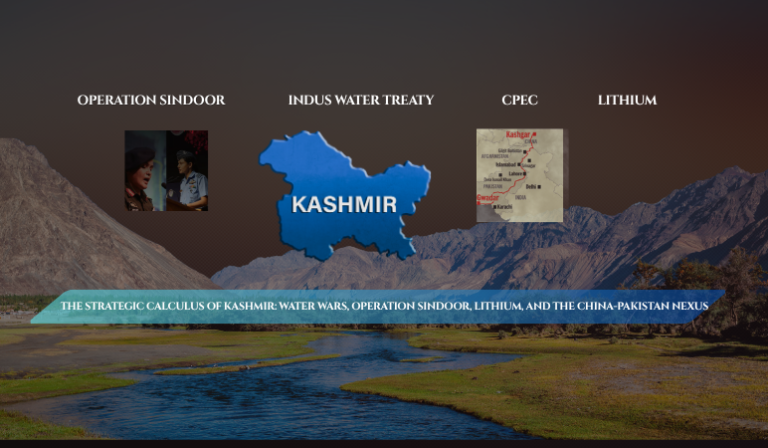
This article aims to examine Kashmir for what it offers, along with answering why the region remains a site of cross-border terrorism, military confrontation and economic competition. This analysis also frames Kashmir as a multidimensional arena where Operation Sindoor, water politics, lithium, CPEC and proxy warfare converge.
Operation Sindoor: Re-engineering India’s Counter-Terrorism Doctrine
“Operation Sindoor” represented India’s tri-service military response to yet another instance of cross-border terrorism by Pakistan. The Pahalgam terror attack occurred on 22nd April 2025 at the Baisaran Valley in Jammu and Kashmir, claiming the lives of 26 innocent civilians. India retaliated on 7th May 2025, aiming to neutralize the operational capabilities of the groups responsible for terrorism on Indian soil.
The Indian armed forces successfully neutralized 9 terror camps using targeted precision strikes, including the Muridke, Bahawalpur and Muzaffarabad camps in Pakistan and Pakistan-occupied Kashmir. In this retaliatory operation, over 100 terrorists were killed, including Jaish-e-Mohammad’s senior commander Abdul Rauf Azhar, the same terrorist involved in the IC-814 hijacking of December 1999. Reportedly, 10 family members of JeM chief Masood Azhar were also killed during the operation.
New Delhi classified Operation Sindoor as ‘focused, measured and non-escalatory’, to highlight India’s strategy of calculated escalation. The entire retaliation was meant to stay below the threshold of a conventional war, without compromising on the immediate military objectives.
The Kinetic Shift: Multi-Domain Precision Strikes –
The most significant dimension of the operation was its multi-domain character, which proved that India possesses the capacity to deploy its military assets across air, land and maritime domains.
The Indian Air Force remained central to the retaliation, leading the controlled yet impactful operation. Its role included not just delivering precision strikes, but also combining intelligence and other assets to give a fitting reply to Pakistan-backed terrorism. To achieve its objectives, the IAF employed layered air-defence systems including India’s indigenous “Akash Surface-to-Air Missile System” to counter aerial threats. Such elements demonstrated that India could operate multi-dimensionally, while avoiding uncontrolled damage.
The Indian Army and the Border Security Force contributed to the wider security effort through border surveillance, air-defence operations and counter-infiltration. As per government records, the army employed advanced systems such as shoulder-fired missiles, air-defence guns and surface-to-air missile systems against Pakistani retaliation, which helped protect military posts as well as critical infrastructure.
Lastly, the Indian Navy’s deployment in the northern Arabian Sea added a maritime dimension to the operation. The deployment of a Carrier Battle Group and several other naval assets were meant to convey a simple message – that escalation would not remain limited to the LoC or air strikes. This put significant pressure on the Pakistani Navy, which remained confined to the Makran Coast, reportedly perceiving the Indian Navy as a potential threat.
Beyond Missiles: Non-Kinetic & Psychological Signalling –
Beyond the kinetic dimension, Operation Sindoor was part of a broader framework meant to put significant pressure on Pakistan and raise the political and economic costs within the country.
The closure of the Attari-Wagah Integrated Check Post was primarily driven by security considerations. But the decision also carried a political and diplomatic angle, meant to reduce the avenues of interaction between the two countries and indirectly punish Pakistan.
Following the Pahalgam attack, India also held the Indus Water Treaty in abeyance, leading to serious repercussions for Pakistan. This arises from the fact that Pakistan remains structurally dependent on the Indus waters for irrigating 80% of its 16 million hectares of cropland, and 93% of its total water use. The Indus River system is single-handedly responsible for food security and prolonged survival in Pakistan.
India has also suspended key imports from Pakistan, including textiles, cement, fruits and vegetables and more. This suspension has imposed immediate economic pressure on Pakistan, which remains burdened by inflation and existing debts. Similarly, a total ban was also imposed on Pakistani artists, suspending their performances, screenings as well as their social media handles, to erase any influence of Pakistani culture on Indians.
The Hydro-Weapon: The Indus Water Treaty and Upstream Leverage
The “Indus Water Treaty”, brokered by the World Bank, was signed between India and Pakistan in 1960, and divided the waters of the Indus River system. India was allowed the unrestricted use of the eastern rivers, namely, Ravi, Beas and Sutlej, while Pakistan was allocated the western rivers of Indus, Jhelum and Chenab, with run-of-the-river Indian rights.
“Blood and Water Cannot Flow Together” –
On 23rd April 2025, India put the Indus Water Treaty in abeyance by temporarily suspending it under certain conditions. The action was a direct consequence of the Pahalgam attack, carried out by a terrorist organization operating out of Pakistani soil.
For over six decades, the treaty had endured various diplomatic breakdowns and violent escalations between the two countries and was hardly questioned by either party. But today, the abeyance reflects India’s changing strategy towards Pakistan, that the Indian government will no longer compromise on the safety of its citizens, nor will it tolerate such cowardly acts of terror.
But in what way would it impact Pakistan?
Pakistan stands as a downstream nation, with 80% of its agricultural land irrigated with these waters. Additionally, the western rivers also account for 93% of its total water use, along with other hydroelectric power generation projects. Pakistan’s entire dependence on the rivers directly affects the 16 million hectares of cropland in the country. This indicates a system of structural dependence, where the western rivers act as the country’s lifeline, feeding major reservoirs and canals to sustain agriculture and subsequently, food security.
India cannot immediately cut off or divert the flow of the western rivers, due to lack of storage and diversion infrastructure necessary in terms of the flow. The scale and geography of the river system, seasonal hydrology, construction constraints and the time required to develop major infrastructure limit how quickly India can alter downstream flows.
But India’s real leverage lies in uncertainty because influencing the timing or the operation of reservoirs or hydropower facilities would create an asymmetry, drastically affecting Pakistan. Thus, India has the upper hand in deciding when Pakistan gets its water and how reliably the country can plan its sustenance.
Pakistan’s response to the situation has further exposed this vulnerability. The government has deemed the abeyance ‘illegal’, associating it with literal ‘water warfare’. The Pakistani officials have threatened that any attempt to stop or divert the flow would be considered an act of war. For Pakistan, this reflects more than just anger and violence – it reflects the fear that this vulnerability might be used against them in the future.
Infrastructure as Deterrence: Dams, Storage, and Irrigation –
In the Indus basin, reservoirs or hydropower facilities function as crucial assets that influence when and how water is stored or released. The IWT previously allowed India to construct infrastructure on the western rivers, with limits in engineering to protect Pakistan’s downstream flows. But owing to the abeyance, India’s hydroelectric strategy regarding the western rivers has moved towards greater control over timings, storage and energy generation. India can now move from merely using the western waters for limited domestic purposes, to designing a larger architecture that diverts surplus flow into water-stressed areas of Jammu and Kashmir, and further into Punjab, Haryana and Rajasthan.
The infrastructural projects of Pakal Dul, Kishanganga and Ratle provide India with strategic leverage over the Indus waters through different but complementary methods. The Pakal Dul project enables India to retain and release the Chenab waters, directly influencing its timing and predictability. The Kishanganga project gives India diversion-based leverage, along with run-of-the-river usage of the western rivers, though limited. Lastly, Ratle, located on Chenab and possessing a planned capacity of 850MW, aims to expand India’s ability to generate electricity and regulate its waters. This combined effect would, therefore, create uncertainty in Pakistan and provide India with greater bargaining power during any future negotiations.
The Lithium Revolution: Critical Minerals and Industrial Sovereignty
Critical minerals such as lithium and rare earth elements have become the lynchpins of the modern economy, popularly regarded as the ‘oil’ of the new age. Lithium-ion batteries, in particular, have become central to green technology. From powering electric vehicles and smartphones to storing renewable energy and driving industrial machinery, lithium has become indispensable for global progress.
Reasi’s 5.9 Million Tonnes: White Gold in the Himalaya –
In February 2023, the Geological Survey of India discovered an inferred G3 resource of 5.9 million tonnes of lithium ore in the Salal-Haimana region of the Reasi district of Jammu and Kashmir. This lithium discovery in Kashmir carries significant economic potential for India, where successful developments could reduce future dependence on global market supply and support India’s battery and EV commitments.
India, therefore, stands at a decisive strategic threshold in harnessing its potential of domestic lithium, as the commercial utilisation of the Reasi discovery depends on developing adequate refining capacity, technical expertise and supporting infrastructure. What must also be taken care of, are the environmental implications that such an extraction carries, where the authority must not undermine the fragile Himalayan ecology and the livelihoods of the local communities. In this regard, while the Kashmir discovery presents India with a strong opportunity for industrial development, it carries with it a responsibility to establish a sustainable model of critical mineral governance.
Denying Foreign Dependence and Boosting National Security –
Geopolitically, the effective extraction of Kashmir’s lithium could potentially challenge China’s monopoly over the global battery supply chain. Currently, China produces approximately 80% of the global battery cells and controls more than two-thirds of the global lithium refining capacity. It not only influences battery manufacturing but also has leverage over the refining process through which lithium becomes usable for advanced batteries.
Presently, India remains 100% dependent on imports of lithium, cobalt, as well as several other critical minerals. For India, China remains primarily important for rare-earth and battery supply imports. Recent data has hinted at approximately 75% of India’s lithium-ion battery imports from China, while the latest FY26 data places the figure at 84%.
Thus, a successful development of the lithium resource alongside domestic refining capacity and battery manufacturing could reduce dependence on Chinese-controlled imports, creating an alternative source of supply. While this would not immediately break China’s monopoly over the market, Jammu and Kashmir could become an important link in India’s strategy to diversify critical mineral supply chains.
Geography, CPEC, and the China-Pakistan Trilateral Pressure
Kashmir’s strategic significance is derived from its location, lying at the junction of South Asia, Western China and the Himalayan frontier. The rough and mountainous terrain acts as a natural barrier, making military movement difficult and expensive. At the same time, its valleys and river routes provide a corridor for regional connectivity.
Also of special mention is the Pakistan-occupied area of Jammu and Kashmir, especially Gilgit-Baltistan, which establishes a geographical link between China’s Xinjiang and Pakistan. Ambitious infrastructure projects such as the Karakoram Highway and the Northern route of the China-Pakistan Economic Corridor are associated with Pakistan-occupied Kashmir, boosting Chinese connectivity with Pakistan.
PoK and the China-Pakistan Economic Corridor (CPEC) –
The advent of the “China-Pakistan Economic Corridor” in 2015 marked China’s most ambitious overseas infrastructure investment under its Belt and Road Initiative. Priced at a staggering $62 billion, CPEC represents Pakistan’s current most prized asset, a transformative economic corridor promising to alleviate energy shortages, modernize infrastructure and foster industrial growth.
But why Pakistan?
This corridor connects China’s Kashgar town to Pakistan’s Gwadar Port, giving China a direct overland route to the Arabian Sea. This direct access cuts China’s dependence on the Malacca Strait, where choke points have been known to cause delays and rising costs. This allows China to strengthen its strategic ties with Pakistan, while also fulfilling its own economic motives.
However, this has caused significant pressure on India from two fronts, namely, China and Pakistan. The problem lies in the corridor passing through a territory belonging to India, that is, Kashmir. The instance has directly challenged India’s sovereignty while also posing a security challenge. The Indian Government has strongly opposed CPEC, deeming it ‘unacceptable’ and a violation of its sovereignty.
Another similar event can be traced to the “Karakoram Highway”, considered the ‘8th Wonder of the World’. The highway marked a historic partnership between the Pakistan Army’s Frontier Works Organization and the Chinese engineers, who worked together to build this modern route of trade and diplomacy. For Pakistan, it anchors the northern entry point of CPEC, which is why repeated significance is now being attached to the Gilgit-Baltistan region of PoK, while simultaneously allowing China to strengthen its footprint over South Asia’s most contested region.
The Two-Front Threat: Tibet, Ladakh, and Water Supremacy –
China is soon to become ‘Asia’s Water Hegemon’, primarily due to its advantageous geographical location. China’s Tibet region is where major Asian rivers originate, including the Siang River which is known as the Brahmaputra in India. As an upper-riparian state to India, China has used this advantage to the maximum by building the “Motuo Hydropower Station” on the Yarlung Tsangpo River. This has allowed China to influence India’s river ecology.
Arunachal Pradesh’s Chief Minister Pema Khandu has expressed concern over China’s stance, arguing that the Siang and the Brahmaputra could dry up upon the project’s completion. While this doesn’t imply that India would receive no supply of these waters, the extent of the impact remains uncertain amidst China’s ongoing construction of the hydropower facility.
At its core, China seeks to harness Tibet’s freshwater resources to the maximum, to aid economic growth, reduce reliance on fossil fuels and address water scarcity. The Tibetan Plateau has reinforced China’s aspirations by providing access to significant water systems. As of 2026, India’s proposal of the “Siang Upper Multipurpose Project”, a counter to the Chinese construction on the Tsangpo River, remains in early planning stages due to opposition from local communities over displacement and environmental concerns. For China, this control over the Tibetan plateau also symbolizes physical occupation and development in the region it considers part of its own country, that is Southern Tibet or India’s Arunachal Pradesh.
Economic Warfare: Tourism, Proxy Violence, and Hybrid Instability
Pakistan engages in proxy wars against India through a system involving militant intermediaries and denied support. The core logic is to avoid direct confrontation with the opposite party, while being involved in training, financing and providing arms to non-state actors. This way, Pakistan-backed terror organizations carry out deadly attacks within our territory, staying well below the threshold of a full-fledged war, while the country itself maintains a position of denied support to such groups.
In Kashmir, proxy wars have been played out to sustain insurgencies, create political turmoil and impose economic implications on India. As analysts describe, Pakistan’s approach can be best described as ‘grey-zone warfare’ that relies on irregular militant intervention, propaganda and religious mobilization, instead of a direct military confrontation. Why? Because nuclear deterrence deems direct escalation as highly risky, forcing Pakistan to resort to terrorism to target civilians, governance institutions, infrastructure or tourism, especially in sensitive regions like that of Kashmir.
Targeted Attacks on Livelihoods and Investment –
“Kashmir jal raha hai, par Pahalgam chal raha hai”
For several years, the phrase captured an important contradiction in Kashmir’s regional economy. While Kashmir continued to suffer from episodes of violence and political instability, Pahalgam appeared to function as a comparatively stable tourism hub, symbolizing Kashmir’s economic recovery.
But the Pahalgam attack of April 2025 directly challenged this model, because by targeting the tourists, it destroyed the confidence that Pahalgam’s normalcy could remain separate from Kashmir’s tensions. The attack can be best categorized as a form of ‘economic warfare’, reiterated by India’s External Affairs Minister, S. Jaishankar. He alleged that the act of terror was aimed at crippling Kashmir’s economy, simultaneously working to provoke religious violence.
In a sudden turn of events, the region’s tourism-driven brand identity was shattered, with Kashmir as a whole coming to be regarded as unsafe, with visitors and investors backing out of planned holidays or investments. The authorities shut down 48 out of the 87 tourist sites in Jammu and Kashmir, leading to a record fall from 469,000 to 259,000 visitors between January and April 2026. It disrupted the wider network of hotels, transport, restaurants and handicraft sellers, resulting in a prolonged loss of income.
The Counter-Strategy: Industrialization, Governance, and Integration –
India’s response to proxy warfare cannot be limited to just increasing security around the tourist sites, as the broader strategy must aim at altering the conditions that allow violence to produce long-term political and economic effects.
Proxy warfare leaves a lasting impact on regions that are often disconnected from wider markets or dependent on a narrow economic sector. Similarly, targeting such a sensitive region’s tourism market directly cripples its economy, producing serious repercussions. India’s counter-strategy remains centred on the creation of sources of employment, investment and wider connectivity, to boost integration with the rest of the country and to ensure that a single attack doesn’t destroy the entire regional economy.
The post-Article 370 framework marked a positive shift towards this strategy, where the Indian government sought to extend national welfare schemes, infrastructure development programmes and investment policies to Jammu and Kashmir. The objective is greater than just administrative integration, but also the creation of an economic tie between Jammu and Kashmir and the greater Indian market.
The “Udhampur-Srinagar-Baramulla Rail Link”, embarked upon by the Indian Railways, stands as living proof of India’s commitment to strengthening Kashmir valley’s integration with the rest of India. Spread over a span of 272 kilometres, the project has an even greater strategic value- lower transport costs, boost in trade and tourism and reduced ability of violence, weather or political shutdowns to isolate the valley. Railway officials treat the project as of national importance because of its contribution to all-weather connectivity and regional economic development.
Along with ambitious infrastructure development, efforts to integrate Jammu and Kashmir into the national economic framework have resulted in larger and significant investments in the region. Official data indicates that the region has received over INR 1.19 lakh crores in investment proposals with expectations of generating approximately 4.61 lakh jobs. These proposals span across diverse sectors of tourism, information technology and renewable energy, aiming to foster economic growth and stability within Jammu and Kashmir.
Conclusion: Kashmir’s Role in India’s Superpower Ambition
Kashmir’s significance can no longer be analyzed by territorial claims alone. Its geography has created a larger strategic space where river ecology, access to critical minerals, military developments, as well as regional connectivity directly influence not only India and Pakistan, but the broader power dynamics in South Asia.
To truly pursue its vision of “Viksit Bharat” and to become a developed nation by 2047, India must work in the direction of inclusive growth, sustainability and effective governance. Kashmir stands not just as a contested territory but as the emerging hub of India’s energy security, industrial autonomy and military deterrence. The real question is whether India can effectively utilise what Kashmir has to offer, without succumbing to cross-border terrorism or regional instability.
Frequently Asked Questions (FAQs)
Q: Mention the Non-Kinetic Measures that Followed Operation Sindoor.
A: The broader framework meant to put significant pressure on Pakistan and raise the political and economic costs included measures such as the closure of the Attari-Wagah Integrated Check Post and the decision to hold the Indus Water Treaty in abeyance. India also suspended key imports from Pakistan and banned Pakistani artists.
Q: Why is the Indus Water Treaty Considered a Potential Strategic Instrument?
A: Following Operation Sindoor, India held the Indus Water Treaty in abeyance, systematically exposing Pakistan’s structural dependence on its western rivers for agriculture, hydropower, and food security. In this regard, India’s real leverage lies in its upstream position and the ability to influence the flow of Indus waters into Pakistan.
Q: Why is Kashmir’s Lithium Discovery Significant for India?
A: Lithium is known to be essential for electric vehicles, battery storage, as well as renewable energy technologies. Commercial developments alongside advances in the manufacturing and refining capacity could reduce India’s dependence on Chinese-controlled supply chains, as well as support India’s EV commitments.
Q: How Has India Reacted to the China-Pakistan Economic Corridor Project?
A: The China-Pakistan Economic Corridor Project has directly challenged India’s sovereignty over Kashmir. Gilgit-Baltistan in Pakistan-occupied Kashmir establishes a link between China’s Xinjiang and Pakistan. The Indian Government has strongly opposed the infrastructure project, calling it unacceptable and a direct violation of its sovereignty.
Q: How does Proxy Warfare Affect Kashmir’s Economy and Political Stability?
A: Proxy warfare enables Pakistan-backed terror organisations to disrupt the political and economic stability in India, without provoking a direct war. By targeting civilians, tourism, infrastructure, and government institutions, Pakistan aims to generate fear and disturbance amongst the community. Furthermore, the Pahalgam attack destroyed the perception that Pahalgam’s normalcy could remain separate from Kashmir’s tensions.