
SINDH UNREST EXPLAINED: MQM, ALTAF HUSSAIN, AND THE DEMAND FOR INDEPENDENCE
This article explores the ethnic conflict in Sindh region of Pakistan with a focus on the Muhajir Qaumi Movement. The MQM is an example of the rise of cultural pluralism in Pakistan. This article examines the emergence of MQM, their demands, its leaders and how the Pakistani government handled this change in cultural demography. Separatist demands from Pakistan in Sindh intertwined with MQM leaders as well. Finally this article evaluates the strategic implications this ethnic conflict has for South Asia, particularly for India-Pakistan relations.
THE ROOTS OF CONFLICT: WHO ARE THE MUHAJIRS AND WHAT IS THE MQM?
The Muhajirs are a community of Urdu-speaking Muslims who had migrated from India to Pakistan. They eventually settled in Sindh as at that time, Karachi was the capital and offered better socio-economic opportunities. However soon, this community felt that they were being discriminated against. The laws and systems that were introduced by the government convinced them that they were being marginalised. So, to give a voice to this community, fulfil their demands and gain recognition as a ‘fifth-nationality’, Muhajir Qaumi Movement, a political party (now known as Muttahida Qaumi Party) came into being.
Partition, Migration and Ethnic Tensions in Karachi (1947-1980s)
The Partition of 1947 had caused a lot of bloodshed and migration. Punjabi Muslims from India migrated to the Punjabi region of Pakistan. The Muslims from other regions, who were from Uttar Pradesh, Bihar, Delhi, Hyderabad, Madhya Pradesh, and Gujarat; preferred to move to Sindh. At that time, Karachi in Sindh was the capital of Pakistan and offered better infrastructure, government jobs etc. which allured Urdu-speaking Muhajirs who belonged to educated urban middle and upper class. This eventually led them to settle down in Karachi and other urban areas of Sindh. Apart from escaping communal violence, one major reason pertaining to this migration was Hijrat. Since Pakistan was a homeland for the Muslims, moving there seemed an act of spiritual significance.
The Muhajirs also include a people called the ‘Biharis’. These were the Urdu speaking Muhajirs who had migrated to East Pakistan during the Partition fled to West Pakistan during the civil war of 1971.
Sindhi Language Bill (1972)
Sooner or later as a consequence of migration, ethnic conflict erupts. The Muhajirs were comparatively more educated than the Sindhis and an Urdu-speaking community. As a result, they used to occupy many government and administrative positions and naturally, Urdu was given more importance as it was also the national language of Pakistan. This made the Sindhis insecure as they felt that they were being dominated by the migrants. To redress these grievances Zulfikar Ali Bhutto’s government passed the Sindhi Language Bill in 1972 making Sindhi the official language of Sindh alongside Urdu. As per the law, Sindhi was to be taught in schools as a second language where the medium of instruction was not Sindhi and provincial government officers were required to learn the language within a specified time-period. The Muhajir college students sat on a peaceful protest opposing the bill. Sindhi students did the same in support of the government’s decision. However soon, things began to get out of control as they started pelting stones at each other. Eventually, serious linguistic riots broke out. Several people were killed and government property was attacked. To curb the situation, the government gave shoot-at-sight orders and imposed curfew. The number of deaths is estimated to be in hundreds. Though the violence came to an end, mistrust and hostility between these communities had already been ingrained.
Introduction of the Quota System
Then in 1973, the Quota system was introduced which gave 60% reservation to rural areas and 40% reservation to urban areas in Sindh province. Muhajirs mostly resided in the urban areas and Sindhis in the rural areas. From the perspective of Sindhi people and the government it was done to correct the historical inequalities. Since urban elites dominated administrative services, quota was introduced to ensure fair representation. Muhajirs opposed this, and to them this was a bigger issue than language as it directly impacted their educational opportunities and career prospects. They argued that their ancestors and them helped build Pakistan and despite being highly qualified they were losing opportunities. This feeling of relative deprivation, where they felt that they deserved more than what they were getting increased their dissatisfaction. Muhajirs now formed the Anti-Bhutto platform and supported PNA in the 1977 elections.
The Rise of Altaf Hussain and the MQM
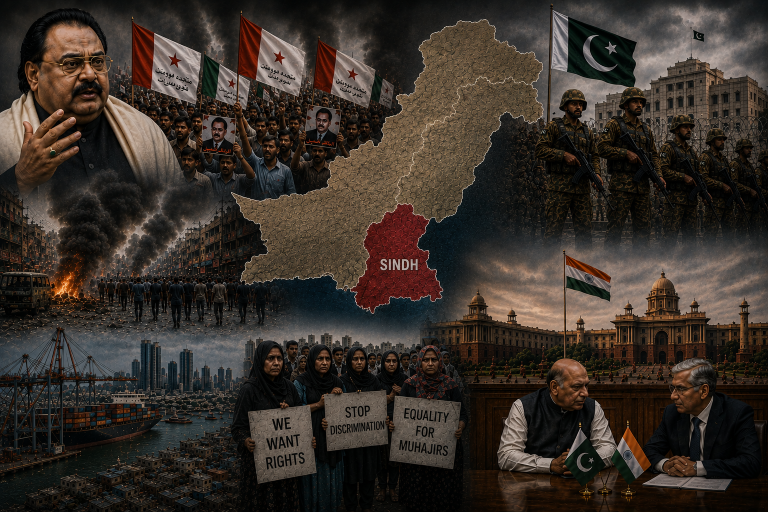
Altaf Hussain was a Muhajir himself. The Muhajirs had often been subjected to discrimination, and the quota system affected the economically weaker Muhajirs the most. Altaf Hussain, who himself came from a modest background and had faced prejudice against Urdu-speaking Muhajirs first hand. He mobilized the lower middle-class and middle class Muhajirs and founded the All Pakistan Muhajir Student Organization (APMSO) in 1978. This acted as the organizational base and eventually the Muhajir Qaumi Movement was formed in March 1984, to represent the political interests of Muhajirs. It opposed the quota system and demanded recognition as a separate ethnic group and claimed that Urdu-speaking Muhajirs constitute the fifth-nationality along with Punjabi, Pathan, Balochi and Sindhi.
FROM POLITICAL POWER TO LONDON EXILE: ALTAF HUSSAIN’S TURMOIL
Altaf Hussain mobilized a distressed section of the community and founded the MQM party which gave Muhajirs a platform to raise their concerns. He was therefore an influential leader who expanded the party’s influence. Although MQM was widely supported, it was also criticised for the violent strikes it conducted. When several of Altaf Hussain’s family members were killed, he feared for his life and eventually fled to London and began to live in self imposed exile. Despite his absence, one phone-call from London stirred up the entire Karachi.
Military Operations in Karachi and ‘Operation Clean-up’
Unfortunately, Karachi became the epicenter of violent ethnic riots and military operations. What initiated the brutal ethnic war between the communities was the death of Bushra Zaidi, a 20-year college student in April 1985 who belonged to the Muhajir community, was caused by a truck accident wherein the driver happened to be a Pashtun. Her death deepened the insecurity of Muhajirs that they were a neglected community which led to brutal ethnic riots between Muhajirs and Pashtuns.
The state of affairs intensified and Pakistan saw merciless rivalry which led to events such as the Hyderabad Massacre in 1988. Accords such as the Karachi Declaration between Benazir Bhutto’s PPP and MQM failed and violence continued.
The Pakka Quila massacre in 1990, revealed that the then conditions of the government were no better than the colonial British government. As the Muhajir dominated neighborhood was besieged, the police seemed to target a particular section of the community. Later, a rally of women and children marched to demand the restoration of water supply that had been shut off due to the siege. The police, who were mostly composed of Sindhis and Pathans tried to stop the procession and when the people did not seem to budge, they opened fire and as the women and children rushed to find a shelter, a stampede was caused. Nearby hospitals did not have enough facilities to tend to so many patients. Surgeries were done in the open corridors of the hospitals. This incident led to the death of many innocent Muhajir women and children.
Operation Clean-Up was launched in 1992 under Nawaz Sharif’s government. The operation was further pursued by Benazir Bhutto, who renamed it Operation Blue-Fox. It was an armed intelligence program which aimed at eliminating terrorists but MQM was the main target. The Sindhi police were supported by the Pakistani Army and Rangers. Together, they targeted the Muhajir Qaumi Movement. This was done because there were allegations that they planned to secede Pakistan and form Jinnahpur, a homeland for the Muhajir community. These were repeatedly denied by the MQM. Altaf Hussain went into self-exile in London as his life was in danger and many others went underground. In 1992, a rival faction was formed, MQM- Haqiqi under Afaq Ahmed and Amir Khan. They were expelled from the party on charges of corruption and they in turn accused Altaf Hussain of being authoritarian. The period also saw one of the deadliest slaughters between Muhajirs and the Sindh Police. The government took steps towards counterinsurgency which stalled the issue to some extent. The program officially came to an end in 1994 but secret killings were still being carried out. After the dismissal of Benazir Bhutto’s government. The lawlessness in this period led to the killing of thousands of people. Many MQM workers were arrested and many disappeared; the missing cases of whom are still registered.
Running Karachi from London: Exile, Treason Charges, and Banning
Altaf Hussain was the founder of MQM. Under his leadership, it became the third largest political party in a very short time. The hostility for the Muhajir community was immense as many saw them as the root for violence that erupts in Karachi. In many different attacks he was targeted and his brothers and nephews killed. During the military crackdown under Operation Clean-Up, he sought political asylum in London and eventually became a British citizen in 2002.
In contrast to what a common man would expect, Altaf Hussain did not stop leading the MQM, he guided the workers through telephone calls.
The Pakistani government has placed many treason charges against Altaf Hussain. He has faced allegations of supporting terrorism in Pakistan, murder, extortion, and kidnapping, etc. In 2009, Pervez Musharaff implemented the National Reconciliation Ordinance, and 72 cases against Altaf Hussain were officially dropped.
Altaf Hussain’s 2016 speech was the most controversial where he criticized the country’s military establishments, the media, and the state as well. The government banned its broadcast from print, media and social media. After that, cases were registered against Altaf Hussain under Pakistan’s terrorism laws. Many MQM offices were sealed and workers arrested.
Following these events, the MQM – London was further split into MQM- London and MQM- Pakistan in 2016. Today, among the three factions of MQM, MQM- Pakistan is the most influential and MQM – Altaf has been dissolved. Today, the MQM- Pakistan faction is known as the Muttahida Qaumi Movement as the party changed its name in 1997. ‘Muttahida’ means united. This change in name showed a change in objective that the party would fight for the rights of all disadvantaged groups as they now aimed to cater to a broader national agenda. However, even after this transformation, today the party still gains a majority of the votes from the Muhajir community.
SHIFT TOWARDS INDEPENDENCE: THE SINDHUDESH DEMAND
Since British rule, Sindhis had demanded independence from the Mumbai presidency. When Pakistan came into being, some nationalists feared that they might be marginalized. So the seeds of the demand for Sindhudesh had been sowed long before the country even came into existence. As a reaction to the declaration of Urdu as the national language of Pakistan, Sindhi Rights Movement Began in 1967 and following the separation of East Pakistan in 1972, GM Syed also demanded a separate state for the Sindhs.
Why Altaf Hussain and Nationalist Leaders Call for a Separate Sindh
Nationalist leaders have always been critical of the atrocities carried out by the Pakistani Army. They accuse the army of increasing economic inequality and reducing democracy and this dissatisfaction is the reason nationalist leaders demand a separate Sindh nation. Hussain has accused them of “persistent assassinations, abductions and enforced disappearances of MQM workers.” He claims MQM to be a secular party, the only party to wipe out right-wing parties, opposing Islamic extremism. He says that Sindh is a state of secular people and is determined that it should not fall prey to “religious fanatics”. Hussain asserts that MQM has always been vocal against the abduction of Hindu women, and when Sindhudesh gets independent, it would be a secular country.
Grievances against ‘Punjab Imperialism’ and Federal Control
Punjab Imperialism or the Punjabization of Pakistan refers to the dominance of Punjabi ethnicity in Pakistan’s military, bureaucracy, and legislature. During colonial rule, many Muslims from Punjab served in the British Indian Army. After Partition, Pakistan inherited a significant portion of this army and as a result there was predominance of Punjabis in the military. They also occupied top military positions due to promotions over time. There was also a comparatively greater focus on the development of education during the colonial era in Punjab and that part of the country was also inherited by Pakistan. This gave Punjab an advantage in educational opportunities, but created disparities in literacy which was resented by the rest of the population. After Muhajir’s domination in the bureaucracy was reduced, particularly due to the regimes of leaders like Zia-ul-Haq, the Punjabis then dominated this sector.
Since the federal government and military were dominated by the Punjabis, such domination led to grievances amongst other communities over Punjabi institutional dominance. They felt underrepresented as even the resources were unequally distributed and used for the development of prosperous regions of Punjab.
ECONOMIC EXPLOITATION AND HUMAN RIGHTS VIOLATIONS
Karachi is the financial capital of Pakistan and generates a significant amount of wealth. However, there is a huge economic disparity. Karachi is in Sindh, but the rest of Sindh is not as close to being as rich as Karachi is. The government is responsible for these economic inequalities because of its negligence. Not only economically, but the public has also suffered due to the various human rights violation acts which were committed by the paramilitary forces of the government as reported by various international organisations such as Human Rights Watch and many others.
Revenue Imbalances: Karachi’s Wealth vs Sindh’s Poverty
Karachi is the commercial hub of Pakistan as it is a major port city. It became the financial and administrative capital of Pakistan after the independence of 1947. Karachi had comparatively better infrastructure than the rest of Sindh. This attracted many entrepreneurs and people who belonged to the educated class. Since it provided better educational and socio-economic opportunities, people from various ethnic backgrounds came and settled here. Even the Muhajirs who had migrated from India during partition came to Sindh, mainly Karachi.
The Muhajirs had attended universities like Aligarh Muslim University, University of Delhi, University of Allahabad and so on. They were educated and hence filled up the positions in bureaucracy, academia and various professions where they helped in the development of educational and economic infrastructure of the city. The rest of interior Sindh’s economy is based mainly on agriculture and trade. Much of its manufacturing is concentrated in Karachi. Any kind of infrastructural or industrial development is highly limited when compared with Karachi. This entrenched economic disparity has been present since the country’s inception and is a major determinant of urban-rural divide which is not only an economic issue but a political one as it is also one of the causes that drives the ethnic conflicts in Sindh.
Enforced Disappearances and State Crackdowns
Operation clean-up was introduced in 1992 with the aim to clear Pakistan of ‘anti-social elements’. However many human rights violations and abuses were carried out by the Pakistani police and paramilitary forces. They made arbitrary arrests and tortured the detainees and many led to their deaths while they were in prison. One main reason for this is seen as the attempt to suppress the Muhajir Qaumi Movement as many were reportedly detained with no formal charges and were denied legal representation. Since the conflict between the MQM and the PPP broke out, police had fired indiscriminately at crowds, women and children, unarmed people and staged them as “police encounters”. Many were allegedly taken into police custody and refrained from contacting any of their family members and were not even presented before the court. The UNHCR has also documented allegations of extrajudicial killings and organisations like Amnesty International and Human Rights Watch have criticised the operation for arbitrary arrests, detentions, extrajudicial killings and torture.
However, the Pakistani State maintains the stance that the operation was necessary to restore law and order, no arbitrary arrests were made and that any action that was taken was simply taken under counter-terrorism and no innocent people were harmed.
STRATEGIC IMPLICATIONS FOR SOUTH ASIA AND INDIA
The Defence Minister of India, Rajnath Singh once commented that ‘Today, Sindh may not be a part of India but civilisationally, Sindh will always be a part of India. As far as land is concerned, borders can change. Who knows, tomorrow Sindh may return to India again.’ This statement was made soon after Operation Sindoor which was in response to the Phalgham attack. India has a connection to Sindh as many Hindus who had migrated from Pakistan to India during partition still consider it their homeland. Even in India’s National Anthem, ‘Sindh’ is mentioned.
Some Nationalist leaders like Shafi Burfat have supported this claim of Rajnath Singh and said that Sindh’s cultural and historical ties have always been with India. While the government of Pakistan has exploited Sindh’s resources.
Pakistan has strongly condemned these remarks as ‘delusional’ and ‘dangerously revisionist’. They called this a Hindutva expansionist mindset trying to destroy the regional peace in the region. Except, the peace in the region has not been threatened by Indians, but by the actions of the Pakistani authorities themselves. Sindhudesh supporters accuse the government of being a “Punjabi Military Establishment”.
The situations were extremely tense when Rajnath Singh made such a remark. It was just after Operation Sindoor was carried out and leaders of JSMM had supported it. However no substantial step has been taken after that by India.
However, if the extreme step is taken, and Indian militarily tries to acquire Sindh, it would be the height of worsened Indo-Pak relations. The whole of South Asia will be affected as countries would be expected to take sides, either militarily or morally. Since both countries are Nuclear States, war is not the most plausible option. This would then have implications for the whole region which would call for diplomatic intervention.
Can Pakistan Hold Sindh Together?
Although there have been demands for a separate Sindh nation by nationalist leaders, it is difficult to say that Sindh will secede from Pakistan in the near future. Sindh does not seem to have enough unity and resources to carry out a successful secessionist movement under Pakistan’s state apparatus.
Also, Sindh has Karachi which is crucial for Pakistan being its financial and commercial hub. Considering Pakistan’s economic challenges, we cannot expect it to let go of its financial capital so easily.
From the Pakistani State’s previous attempts we can see that it has always tried to keep Sindh as an integral part of Pakistan. One of the earliest attempts of its government was to introduce a Language Bill to give recognition to the Sindhi community, and introduction of the Quota System. However when these developments were opposed by other communities such as the Muhajirs, we see a failure of the Pakistani government to appease the public. It then went on to perform military crackdowns, committing extra-judicial killings and failed to put an end to the ethnic riots between the communities. But rather than solving ethnic tensions, it intensified them further. People experienced violence, were abused, and were victims of extra-judicial killings. If the government continues following coercive measures, demands for a separate nation might gain momentum and even if Pakistan’s territorial integrity remains intact, tensions in Sindh will not reduce.
CONCLUSION
The Muhajirs were largely an educated urban class who had migrated from India and regarded Pakistan as their homeland. They played an important role in the country’s early development as they also occupied significant bureaucratic and administrative positions. However, over time differences developed and they faced ethnic discrimination. When the government introduced new bills and systems, these intended to address the grievances of one section of the population – Sindhis, but they simultaneously infuriated the Muhajirs. They did not take into account the relative deprivation that the Muhajirs felt. As ethnic violence erupted, instead of focusing on solving the ethnic differences by institutional reforms and promoting dialogue, the government relied on suppressing them by force.
In 1984, Altaf Hussain formed the Muhajir Qaumi Movement party and it gained popular support as it gave the Muhajirs a platform to articulate their demands and a better chance of recognition. The recurring ethnic riots disproportionately affected the Muhajirs and MQM earned a controversial reputation, particularly in the eyes of the government for being the instigator.There were many military crackdowns that cost innocent lives. Many of these seemed to specifically target the Muhajirs, but the most significant was Operation Clean -Up. International organisations like Amnesty International, Human Rights Watch and many others reported allegations of extrajudicial killings and enforced disappearances. It also led Altaf Hussain to flee from Pakistan to London where he went into self-exile to save his life and guided the MQM workers through his “telephone sermons”. The MQM Party fragmented into several factions. In 1992, MQM was split into MQM – Altaf and MQM Haqiqi. The MQM – Altaf Party was further split into MQM- Pakistan in 2016, and this faction of the party is the most influential which is known as the Muttahida Qaumi Movement now while MQM- Altaf has been dissolved.
Demands for Sindhudesh, a separate Sindh nation, have been supported by well-known leaders like Altaf Hussain along with other nationalist leaders. Plus the Indian government’s Defence Minister’s comment that Sindh has always been a part of India civilisationally and one day the land might return back to it, invited a strong response from the Pakistani government and accused them of trying to disrupt the regional peace of the region. However, internal peace of Sindh has been long disrupted due to the exploitation of resources and indifferent treatment by the government of Pakistan. The article also discusses the possibility of a full-fledged war between the two countries, which is quite rare, since it would involve diplomatic intervention. However, if Pakistan continues to respond to ethnic and cultural recognition demands with force, the peace in Sindh seems unlikely to be restored.