
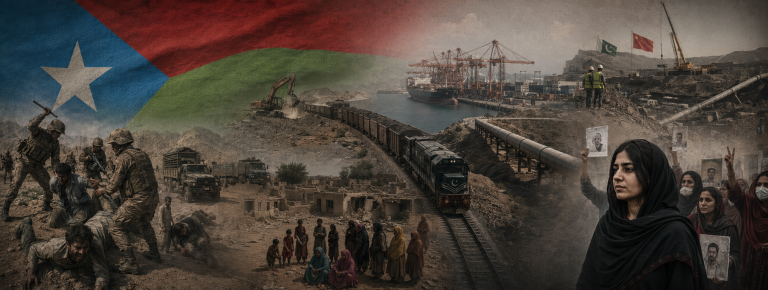
WHAT IS HAPPENING IN BALOCHISTAN RIGHT NOW?
How does a province covering a massive 44% of the country become its most neglected and contested region?
The Baloch insurgency stems from the historical episode of Kalat’s forcible annexation into Pakistan. This is a settled legal matter for the Pakistan government, but for the Baloch, this marked the end of their sovereignty and their ethnic identity.
Balochistan, the country’s official ‘treasury’, shares borders with Iran and Afghanistan, and houses a wealth of copper, gold, natural gas, and rare earths. The province is crucial to China’s infrastructure dream, the “China-Pakistan Economic Corridor”, despite its negative aftermath that the Baloch have been subjected to.
But today, Balochistan is burning, and they are demanding independence and recognition from the international community, something that had been abruptly snatched from them all the way back in 1948.
BALOCHISTAN LIBERATION ARMY
Early 2026 saw coordinated attacks across 12 different cities of Quetta, Nushki, Pasni, Mastung and Gwadar, simultaneously, and the reports claimed the group had taken control of Quetta’s main market. In May 2026, dozens were left wounded and over 20 people were killed in the Quetta Train Station bombing. And the most recent, an 8-bus military convoy near Mastung was hit, killing 45 soldiers.
All these meticulously planned and executed attacks have been credited to a key player in the Balochistan politics, the “Balochistan Liberation Army”. For the Baloch and the Indians, the BLA stands as a ‘freedom fighting’ group, demanding full sovereignty and not just provincial autonomy, but for Pakistan and several Western powers, the Baloch force has been branded as a terrorist organization threatening to divide the country.
While the Baloch insurgency has been ongoing since 1948, a pivotal event occurring in 2006 changed the dynamics of the movement. Nawab Akbar Khan Bugti, former Chief Minister and Governor of the province, was killed in a military operation. The killing of their celebrated political leader worsened the situation, transforming the political protest into an armed rebellion. Since then, the Baloch independence struggle has largely been based on the core issues of forced annexation, resource exploitation, human rights violence and marginalisation of the Baloch community.
Today, the BLA functions as a highly coordinated organisation, launching targeted attacks on their own country’s infrastructure, military bases, and especially, the Chinese-backed developmental projects, such as the 2023 attack by the Majeed Brigade on a convoy of Chinese engineers or the Karachi attack in 2024, leaving 2 Chinese nationals and at least 10 Pakistani soldiers dead. Such attacks were a direct result of the surging anti-Chinese sentiments, highlighting how their money is not welcome in Balochistan, which has been far from beneficial.
THE 75-YEAR HISTORY: HOW THE BALOCHISTAN CONFLICT BEGAN
THE 1948 ACCESSION OF KALAT AND EARLY REBELLIONS
“Balochistan is not Pakistan” is what every Baloch is repeating today.
Ironically enough, Balochistan was never a part of Pakistan, not until 1948. The present-day province of Balochistan earlier existed as an amalgamation of princely states and tribal territories, broadly referred to as the “Khanate of Kalat”.
Mir Ahmad Yar Khan had decided on Kalat’s independence, formally announced on August 12, 1947, through a proclamation of independence, which thrived for 227 whole days.
Eventually, in March 1948, the Pakistan military forcibly annexed Kalat, threatening to destroy the state unless the Khan surrendered. Despite being deemed ‘illegal and oppressive’ by the people of Kalat, the annexation was the result of an elaborate strategy involving military operations and territorial isolation.
How? Because when the princely states of Makaran, Kharan, and Las Bela acceded to Pakistan, the state of Kalat became trapped in a ‘landlocked’ situation. This raised a concerning question on Kalat’s future status of sovereignty. Furthermore, in March 1948, rumours of Kalat’s potential merger into India raised alarms in Pakistan. An “All India Radio” broadcast featuring V.P. Menon publicly announced the state’s wish to merge into India, which was rejected by Jawaharlal Nehru on the pretext of geographical impracticality. In the end, Pakistan acted quickly and impulsively, thereby stripping Kalat of its deserved autonomy.
However, also of significance regarding Kalat’s history is Mohammad Ali Jinnah’s name and his backstabbing role. Because Jinnah, the state’s lawyer and well-wisher, had initially backed their claim of independence. But later, the leader started pressuring the Khan to accede into Pakistan, partnering with the Pakistani forces to compel the very person he had initially supported.
THE FIVE WAVES OF BALOCH INSURGENCY
1. FIRST WAVE: THE CONTESTED ANNEXATION
The first wave of the Baloch insurgency broke out in 1948, immediately after the forced annexation of the state of Kalat into Pakistan. The Khan’s younger brother, Prince Abdul Karim, rejected the annexation and led a localized revolt in the Jhalawan Hills. While this supposedly sowed the seeds of Baloch nationalism, an overwhelming population did not support the rebellion, and participation was limited to a few dissatisfied elites and tribesmen.
2. SECOND WAVE: THE ONE UNIT SCHEME
The second insurgency dates back to the “One Unit” scheme introduced in 1955, which illustrated the government’s focus on strong centralization rather than provincial autonomy. Through this scheme, the Pakistan government aimed to merge the four provinces of West Pakistan, including Balochistan. The tribesmen feared the end of their ethnic identity and autonomy and therefore led an armed uprising under Nawab Nauroz Khan. The phase ended in tragedy when Nauroz agreed for peace talks with Pakistani representatives, only for his sons to be executed by the state and Nauroz imprisoned.
3. THE THIRD WAVE: THE PARRARI MOVEMENT
The “Parrari movement” represents the third wave of the Baloch insurgency in 1962-63, led by Sher Mohammad Marri, the chief of the Marri tribe. The movement was sparked due to the government’s efforts to establish permanent military cantonments in strategic tribal areas, which the people feared was an attempt to crush their autonomy and take control of their land. Insurgents, in retaliation, targeted trains, convoys, and infrastructure, escalating the movement until a ceasefire was achieved in 1969 following the fall of President Ayub Khan and the dismantling of the scheme.
4. FOURTH WAVE: THE DISMISSAL
In 1973, Prime Minister Zulfikar Ali Bhutto dismissed the democratically-elected government of Balochistan, led by the National Awami Party. The centre alleged that the NAP had been involved in separatism and treason, hence the dismissal. This led to the start of yet another insurgency, with hundreds of Marri and Mengal tribesmen taking up arms. The phase is said to have ended in 1977, when General Zia-ul Haq overthrew the Bhutto government and declared general amnesty for the Baloch insurgents.
5. FIFTH WAVE: THE DEMAND FOR INDEPENDENCE
However, the Baloch community continues to fight for their due, marked by the longest and most current wave of Baloch insurgency, running from the 2000s. They demand recognition as a solution to the underlying political grievances of the Baloch. Their coordinated rebellion includes organized militant groups and attacks targeting military and Chinese infrastructure, because the grievances have intensified, and the government continues to treat it as a security problem.
WHY IS BALOCHISTAN RESENTING CENTRAL CONTROL?
RESOURCE EXPLOITATION vs LOCAL POVERTY
Pakistan has been famously following a model of “Resource Colonialism” in Balochistan, continuing to treat the province as a ‘treasury’ from where it can mine out rich resources and use them to reap huge profits. What should have aided the community’s development turned out to deprive them of the benefits from their own resources.
The Sui gas field in Balochistan remains a classic example to understand how this model operates. The discovery of natural gas in Sui town of Balochistan in 1952 is remembered as one of the most significant energy finds in Pakistan’s history. For the Baloch, this should have marked a turning point in their lives, guaranteeing them economic equality and the benefits their government had always promised. The bitter truth, however, was that the Sui gas continued to illuminate the houses and industries in Sindh and Punjab, while the Baloch relied on firewood. The provincial capital, Quetta, received gas connections in the 1980s, while the town itself was connected around 1990. Even in that scenario, preference was given to the military cantonments and industries, where they again sidelined ordinary citizens.
The ground reality poses a completely different picture of what has been enshrined in Pakistan’s Constitution. As per Article 158, the province which houses the well-head of natural gas can avail ‘first use’, over other provinces. Despite being added in 1973, Balochistan continues to be comparatively deprived of the resource’s use. Court judgments have failed to close the massive implementation gap between Balochistan’s own resources and their right to avail the benefits and profits arising out of those very resources.
GWADAR AND CPEC
“CPEC is not a development project for the people of Balochistan. It is a tool of exploitation that has only brought more suffering to our land. Our resources are being taken, our environment is being destroyed, and our people are being displaced, all in the name of development.”
In November 2021, the Baloch population was out on the streets of Gwadar for several weeks, not demanding independence but basic necessities of water, electricity, and the right to fish in their own waters. The “Gwadar Ko Haq Do” movement started out as a struggle against the CPEC project, which should have been a boon for Balochistan, but turned out otherwise.
The “China-Pakistan Economic Corridor” stands as a massive $65 billion development initiative, considered transformative for Pakistan’s economy. With Pakistan’s connecting point lying in Balochistan’s Gwadar, the CPEC promised a boost in infrastructure, energy, and trade, but what the people have received in turn has simply added to their long list of grievances.
For decades, the Gwadar port had allowed the local Baloch fishermen to practice fishing freely, that is their livelihood they had been practising all their life. But now, a Chinese deep-sea port dominates the coastline, with their Chinese fishing trawlers sweeping the waters and taking away their fishes, systematically dismantling their livelihood.
And to add to the anti-Chinese sentiments, the Baloch community has not been involved in the infrastructural development project at all. While a layman might suppose that big projects would mean the generation of more jobs for the community, the project’s workforce actually comprises of an overwhelming number of labourers from the Punjab province, completely neglecting the Baloch.
CPEC alone hasn’t fueled this outrage, as other Chinese-run projects like the “Saindak Copper and Gold” project of 2001 have been indefinitely leased to the Metallurgical Corporation of China, with the latest extension in 2023. Statistically, China and Pakistan receive a 60% and 38% share, respectively, with only 2% of the revenue share being returned to Balochistan, further fueling their sense of neglect and economic deprivation.
Their own province’s infrastructure is being controlled by the Chinese, such as the Gwadar Port, where all operations of the port have been leased to the China Overseas Port Holding Company, marking yet another Chinese intervention. Out of every rupee that comes out of this port, about 91 paise goes to the Chinese company, and the remaining 9 paise goes to Pakistan, excluding Balochistan from the entire equation.
A fundamental question arises: why only Pakistan?
The “Malacca Dilemma” had laid the foundation behind China’s investment in Pakistan. The term was coined by former Chinese President Hu Jintao and arose out of China’s limited alternatives for energy import routes and its exposure to potential naval blockades. The Strait of Malacca handles an estimated 25-40% of global maritime trade, transporting over $3.5 trillion in goods, simultaneously functioning as the shortest route connecting the Indian Ocean to the South China Sea. Hurdles may arise incase of a choke point scenario, the very reason which forced China to pivot towards a strategic alternative, hence the CPEC. This would provide China with an overland route, completely bypassing the strait.
While this infrastructural project has provided China with a strategic route, it has instead added to the many grievances of the Baloch. But after analysing the history, it’s no surprise that the Baloch have been sidelined from any involvement or say about developments revolving around their region or resources.
HUMAN RIGHTS CONCERNS AND ENFORCED DISAPPEARANCES
Pakistan’s response to the Baloch grievances has been far from diplomatic, because rather than involving in peaceful negotiations, the government has chosen the “kill and dump” policy, relying on enforced disappearances and extrajudicial killings of any Baloch who dares raise their voice.
An interesting pattern to note is that the person is neither arrested nor charged, but simply taken away from their homes, and no one knows whether those taken would return alive or not, as several media reports have established the names of real people who have gone missing or returned dead.
-
- Riaz Bugti Baloch, from the Dera Bugti district, was tortured and lost his life on July 10.
-
- Zehri Khan Musiani, Shakar Khan, Sanaullah Musiani, Umeed Ali Khan, Dost Muhammad, and Irshad Ahmed— all forcibly disappeared. Their whereabouts remain unknown.
-
- Noor Marri, abducted by Pakistan ISI from Bisima area, tortured and slow-poisoned. The court released him, but he was martyred due to deep injuries.
-
- Haji Jan Mohammad Marri was abducted by the ISI and subjected to severe torture. He was later released but abducted for the second time, and his body was dumped.
-
- Gula Khan Marri, arrested and subjected to third-degree torture… with his hands nailed to the wall. Today, he suffers from paralysis and permanent damage in his hands.
The above-listed names disregard the Pakistani claims of it being pure theory or exaggeration. One can now establish the fact that this is a strategic move by the Pakistan army to dismantle the legitimate Baloch freedom struggle. These practices aim to instill fear in the general public while they work at dismantling the very core of their struggle, that is, the leadership.
Why? Because the government is well aware that the idea of independence cannot be erased, and so they have been focusing on suppressing the people carrying those very ideas, that is, the youth and the activists. This portrays a simple message – “Activism will cost you, with death.
THE CASE OF MAHRANG BALOCH
Mahrang Baloch, the community’s leading human rights activist, is someone who has been long associated with the cases of enforced disappearances. She has spent years campaigning against the government’s cruel tactics of disappearances and killings in Balochistan. Her activism stems not just out of societal concern, but out of personal trauma of her father being murdered in custody and her brother abducted by the military.
Famously referred to as “Balochistan’s Lioness”, she has fought hard and strong to bring Baloch matters in the public eye. Through her platform, the “Baloch Yakjehti Committee”, she aims to bring an end to such unlawful enforced disappearances of the Baloch, simply because they dared raise their voice for independence. Mahrang’s narrative focuses more on human rights abuses and economic injustice, to bring to the attention of the international community.
However, the Pakistani government has responded by sentencing Mahrang Baloch and her fellow activist, Sibghatullah Shah, to life in prison after an Anti-Terrorism Court in Quetta found both active in the illegal gathering of the Baloch Unity Committee, and guilty in the death of a paramilitary soldier. As stated earlier, Pakistan has opted to suppress the voices of its own people, instead of a diplomatic negotiation.
STRATEGIC IMPLICATIONS FOR INDIA AND SOUTH ASIA
The Balochistan crisis will not just impact Pakistan’s regional stability alone, but will also pose implications on India and the broader South Asian security angle. Balochistan, threatening to break away, has left India at a diplomatic crossroad, with either road carrying one or the other repercussion. For China, Balochistan carries a major significance, as the Gwadar Port project is only one of the many ambitious developments within CPEC. A territorial threat to Pakistan directly threatens China with rising infrastructural costs and uncertainty about the strategic route. Since Balochistan borders Iran and Afghanistan, any further escalations impacting the two neighbours could cause unrest in a region marked by unease and conflicts. Thus, Balochistan is no longer a provincial conflict, but a case that could drastically affect the regional diplomacy of the entire South Asia.
HOW NEW DELHI VIEWS THE BALOCHISTAN CRISIS –
Pakistan has usually pointed to India, blaming New Delhi for backing Baloch insurgents and how they are “Indian proxies” threatening to disrupt the country’s stability and world image. However, such allegations have never been supported by proof, and India has always denied involvement in such baseless rumors, urging the country to instead participate in diplomatic talks to solve the Baloch grievances.
While India has, at certain UNHRC meeting occasions, advocated for a resolution to the human rights abuses subjected to the Baloch, diplomatic repercussions have stopped India from extending any official support or aid to the community. This is because official recognition of the province as a separate country carries a potential escalation with Pakistan and a diplomatic fallout with China. But religious and civilisational roots connecting both India and Balochistan pose a moral obligation before our country, to help Balochistan in times of crisis.
CONCLUSION
The Balochistan conflict has survived since 1948, only because the Pakistan government continues to treat their own people as a security issue. What lies behind the rebellion is decades of political neglect, human rights abuse, and economic exploitation. Their own government has responded to the promises of autonomy and development with force and suppression. Strategic projects such as the CPEC and Gwadar Port have done nothing for the Baloch community, but have further pushed them into economic deprivation, leaving them with a sense of marginalisation.
At the same time, the human cost of struggle cannot be ignored. The increasing cases of enforced disappearances and extrajudicial killings have deepened the anger within the community. The Balochistan conflict is no longer Pakistan’s internal matter, as neighbouring countries like India and China have become connected in differing ways. What unfolds in the future is expected to leave its lasting mark on South Asian dynamics.